Flying With a 2-Year-Old: The Hardest Age, Solved
Two is the hardest age to fly, and the reason is structural: your child now needs a paid seat, has the strength to fight being in it, and hasn’t yet developed the patience or the screen tolerance that makes three so much easier. The fix is to stop improvising. Buy the seat, decide the restraint before you get to the gate, and go in with an hour-by-hour plan and a scripted response to the meltdown you already know is coming. Here’s how that looks in practice.
The birthday changes the booking
On the day your child turns two, they need their own ticketed seat on US flights — no lap-infant option, domestic or international. Three consequences worth planning around:
- Check the return date, not the departure date. A child who is 23 months when you fly out and turns two on the trip needs a purchased seat for the flight home. Airlines do enforce this, and finding out at the gate is a very bad morning.
- Bring proof of age. A birth certificate or passport copy settles any question at check-in, especially if your child is tall for two.
- Book seats together at purchase. Airlines are generally required to seat young children next to an accompanying adult on US flights, but the smooth version of that is choosing the seats yourself rather than relying on a gate agent to reshuffle a full aircraft.
The upside of the paid seat is real: a two-year-old belted into their own space with an armrest boundary is dramatically easier than the same child on your lap. You have already bought the hardest part of the solution.
Restraint: car seat, harness, or nothing
Three legitimate options, and the right one depends on what happens after you land.
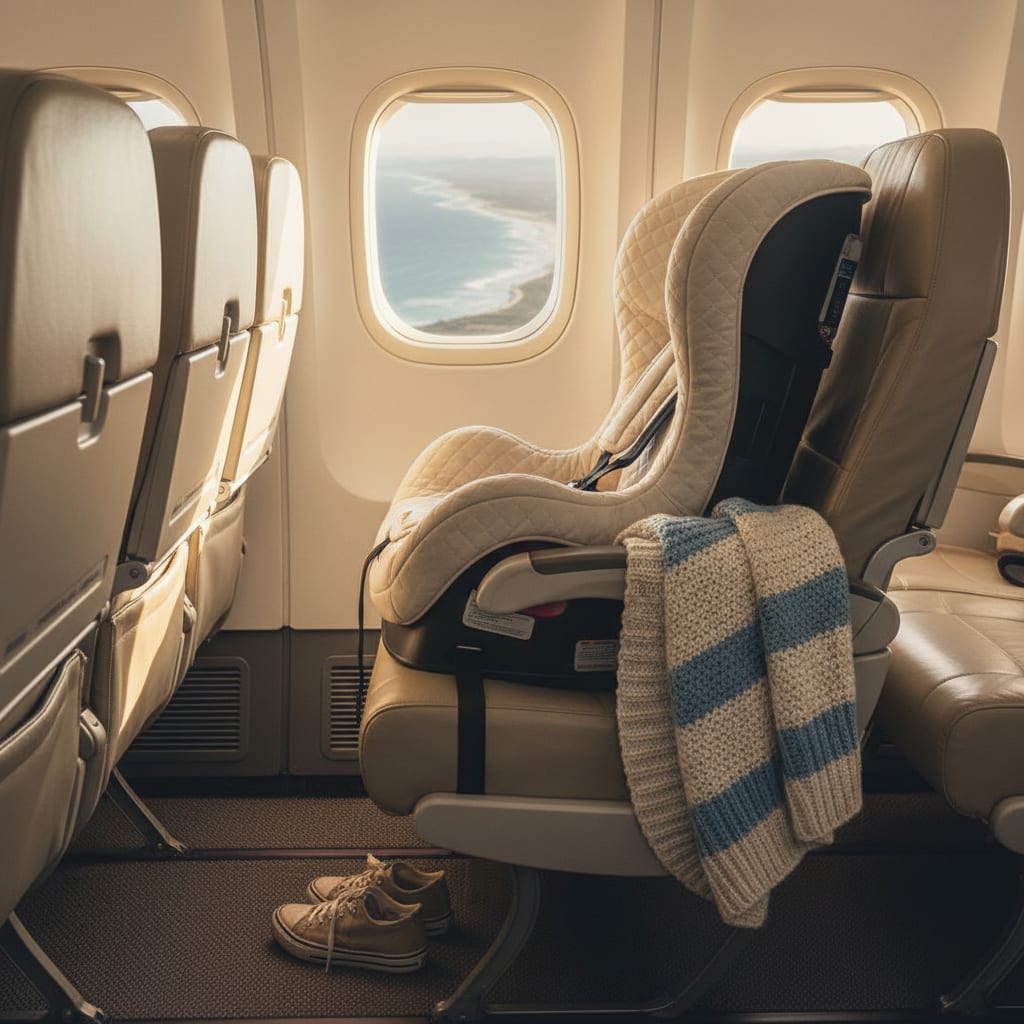
Bring the car seat. The FAA recommends children fly in an approved child restraint system, and there is a practical argument on top of the safety one: your child already knows this seat, already falls asleep in it, and cannot climb out of it. If you need a car seat at your destination anyway, carrying it is often less work than renting a mystery one. Check the label says it is certified for use in aircraft, and measure the width — a seat over about 16 inches struggles in economy.
Use an aviation harness. The CARES harness is the FAA-approved alternative for children aged one and up, roughly 22–44 pounds and under 40 inches, and it weighs about a pound. It loops over the seatback and works with the regular lap belt. If you’re renting a car seat at the other end or being met by grandparents who have one, this is the bag-friendly answer.
Use the seat belt alone. Perfectly legal once they have their own seat. It’s also the option with the least restraint at exactly the age with the most climbing, so go in knowing that.
The hour-by-hour plan
Two-year-olds do badly with open-ended time and well with structure, so give the flight a shape.
T-90 minutes, at the airport. Movement, not sitting. Walk the terminal, find the window with the planes, ride the walkway. Do the potty stop or diaper change at the gate.
Boarding. Send one adult on with the bags at group one and keep your child moving until final call. Fewer minutes strapped in on the ground is fewer minutes of patience spent before you’ve moved.
Takeoff to hour one. Do nothing. Genuinely — no toys yet. The window, the seat belt, the tray table and the safety card carry the first thirty minutes, and every activity you open now is one you don’t have at hour three.
Hour one to two. Snacks on a drip, small activities one at a time, an aisle walk when they get twitchy rather than when they erupt.
Hour two onward. Screen time, with headphones, guilt-free. It works far better held back than led with.
The last hour. Hold back the best snack and one unopened surprise for exactly here, plus something to drink at the top of descent for ear pressure.
The tantrum-at-altitude script
Assume it happens. What matters is that your response is decided in advance rather than invented at 36,000 feet.
- Go low and quiet. Kneel or crouch, drop your voice below the engine noise, and get physically close. A loud correction in a confined cabin escalates a two-year-old every time.
- Name it, don’t solve it. “You’re really mad. You wanted the blue one.” Two-year-olds meltdown because they have no words for the feeling; supplying the words shortens the storm.
- Change the location. The galley, the aisle, standing up in the window seat — the physical scene change resets more tantrums than any toy.
- Don’t spend the stash. Cycling through every snack and toy mid-tantrum burns your entire reserve and rarely stops it.
- Let it end. It will, in three to eight minutes, and everyone around you will forget it in ten.
Toddler airplane entertainment deserves its own plan — my flight-length-sorted activity list is what I actually pack. The broader logistics for the whole one-to-four range are in flying with a toddler.
FAQ: flying with a 2-year-old
Does a 2-year-old need their own plane ticket?
Yes. From the second birthday, a child needs a purchased seat on US flights. Lap-infant travel ends on that date, including on the return leg of a trip that started before it.
Is a car seat or a CARES harness better on a plane?
Whichever matches your destination. If you need a car seat when you land, bring it — the familiarity is worth it. If you don’t, the harness is FAA-approved, weighs a pound, and saves you dragging a car seat through three airports.
Do 2-year-olds sleep on planes?
Some do, most eventually do on flights over about four hours, and almost none do on the schedule you’d like. Bring the comfort object, dim what you can, and treat sleep as a bonus rather than the plan.
What’s the best flight time for a 2-year-old?
Mid-morning, after a full night and near the start of their day. Red-eyes work for some families on long-hauls, but a two-year-old who doesn’t sleep on an overnight flight makes the next 24 hours very long — worth reading best vacations with toddlers before committing to a route that requires one.