Bedtime After Moving Abroad: The First Weeks in a New Home
Bedtime after moving abroad is not jet lag, and treating it as jet lag is why the second week feels worse than the first. The clock adjusts in roughly a week. The house takes a month or more — new light, new sounds, a room your child did not choose, and two parents who are also sleeping badly in it. Fix the sleeping space and the sequence first, hold the local wake time, and expect settling to be measured in weeks rather than nights. Nothing is going wrong.
Jet lag is a clock problem. This is an everything problem
If you flew somewhere for ten days, the clock was the whole story, and our baby jet lag and toddler jet lag guides cover that on its own terms: light in the morning, hold the local schedule, ride it out.
A move is different, and it is worth naming why. The NIH’s National Institute of General Medical Sciences puts it plainly: light and dark have the biggest influence on circadian rhythms, but “food intake, stress, physical activity, social environment, and temperature also affect them.”
Read that list against a relocation. Different light. Different food, on a different eating schedule the whole country keeps. More stress, for everyone. A different daily amount of running around, because you don’t know where the park is yet. An entirely new social environment. And a house that heats and cools differently from the one you left. Every input on that list changed on the same Tuesday.
So when the clock is back on track by day eight and bedtime is still a mess by day twenty, that is not a failure. It is the other five variables, still moving.
Fix the room before you fix the routine
The single highest-return day of the first fortnight is the one where you deal with the sleeping space, because you will be living with it for a year rather than a weekend.
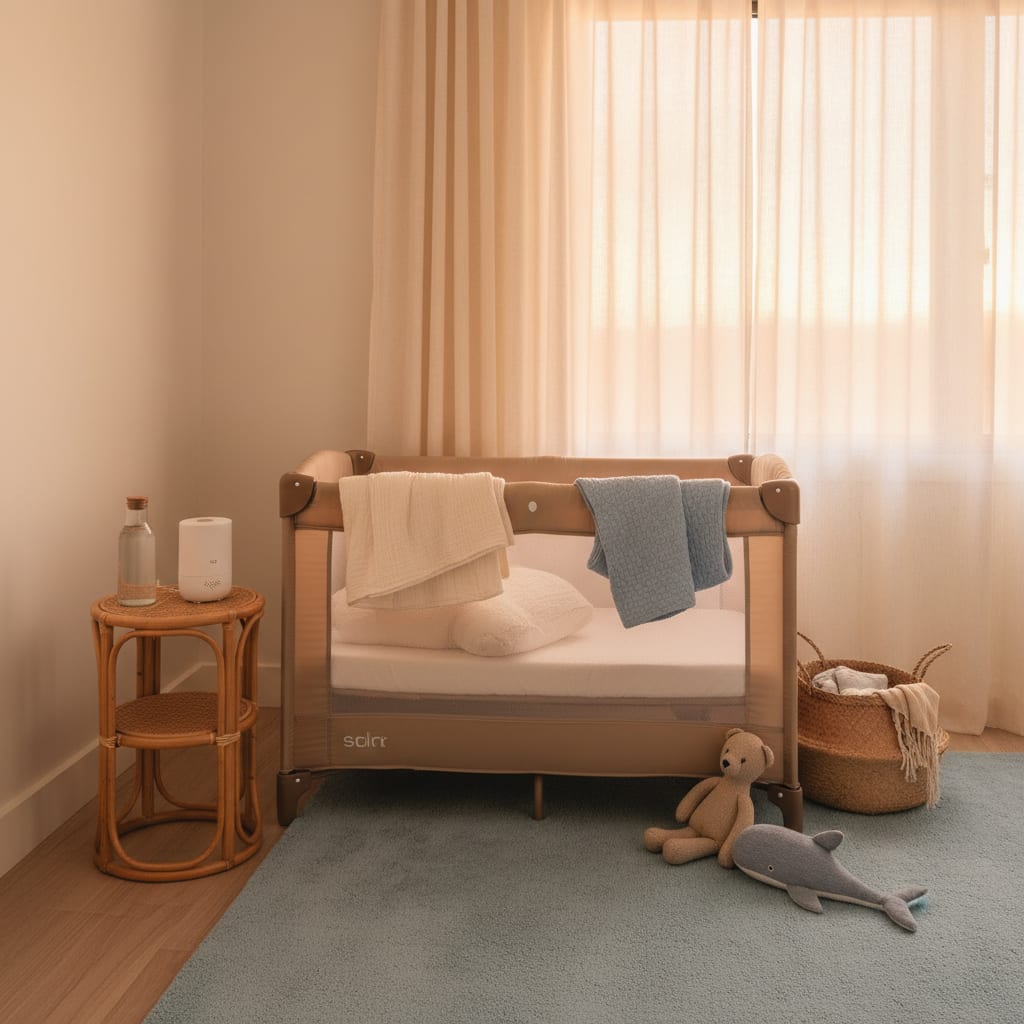
Do the safe-sleep check on night one, before anything else, especially if the cot or bed came with the rental. NIH’s Safe to Sleep campaign describes a safe infant sleep surface as firm, flat and level — firm meaning it returns to its shape quickly when pressed, flat “like a table, not a hammock”, not at an angle, and covered only with a fitted sheet. Furnished rentals in a lot of countries hand you a soft mattress, a folded quilt as bedding, or a cot that has been in a cupboard since 1998. None of that is a judgement on where you’ve moved; it’s just not what you’d have bought. Betteroo’s rundown of what makes a safe sleep setup is a useful checklist to run in an unfamiliar bedroom.
Then deal with the light, which in a new country is genuinely different and not in a way you can reason about from your old timings. Sunset moves with latitude and with where you sit inside a time zone, and shutters, blinds and curtain conventions vary enormously — many warm-climate rentals have serious exterior shutters and no curtains at all, and plenty of northern apartments have the reverse. Go and look at the actual room at the actual bedtime hour, twice, before deciding anything.
A suction-cup travel blackout like the Tommee Tippee portable blackout blind is the fast fix while you work out the permanent one, since it goes up in about a minute and does not need a drill or a landlord’s permission. Then get the permanent version sorted inside the first month rather than living on the temporary one until spring.
Sound is the third piece and the one people leave too long. Scooters, church bells, a lift shaft, neighbours whose evening starts when yours ends — you cannot change any of it, so cover it, from night one rather than week three.
Carry the sequence, not the room
The room is gone. The sequence is the thing you actually packed, and it is the only part of bedtime that survived the flight intact.
Run it in the same order and at the same length as you did at home, even in a half-unpacked apartment, and even on the nights it feels absurd. Same order, same songs, same words at the door. Children read sequence as safety far more than they read furniture, which is the same mechanism behind why the second night away from home is so often the hard one — the novelty has worn off and the familiar structure hasn’t arrived yet.
If your routine had gone vague over the summer or the move itself, this is the moment to rebuild it properly rather than improvise: a solid bedtime routine is doing more work here than it ever did at home.
One rule holds everything else up: the local wake time does not move. Not for a rough night, not for a late dinner, not for the jet lag, not for the week the school placement is still being sorted. Everything else can flex.
What the first six weeks actually look like
| When | What’s normal | What to hold |
|---|---|---|
| Days 1-7 | Clock chaos, 3am parties, naps in the wrong places | Local wake time, morning daylight, the sequence |
| Week 2 | The clock lands but bedtime gets worse — the room, not the time zone | Sleeping space fixed, darkness sorted, no new tactics |
| Weeks 3-4 | Clinginess, more night wakings, resistance at the door | Same sequence, more daytime presence, boring nights |
| Weeks 5-6 | Genuinely settling; the odd bad night stops meaning anything | Routine unchanged as school and childcare start |
Week two is the one nobody warns you about, and it is where most families start changing things. Don’t. Changing tactics in week two turns one variable into four, and you lose the ability to tell what helped.
The adults are displaced too
Everybody plans the children’s sleep and nobody plans their own, and then the fourth week arrives and two exhausted adults are doing bedtime by argument.
Two things are worth deciding out loud in the first week. Who is on nights, and for how many nights in a row, given that jet lag hits adults hard and admin — visas, banking, schools, a phone that works — eats the daytime. And what “we don’t change anything for a month” means in practice, so that neither of you renegotiates bedtime at 9pm on a bad Tuesday.
Then get outside every single morning, all of you. It’s the cheapest circadian tool there is, it works on adults as well as children, and it doubles as the fastest way to learn a neighbourhood.
FAQ
How long until my child sleeps normally after an international move? The time-zone part usually resolves in about a week. The settling part — new house, new sounds, new everything — commonly runs four to six weeks, and longer if childcare or school starts partway through. Slow is normal here; it is not a sign the move was wrong.
Should I keep the old country’s bedtime for a while? No. Go local from the first full day, using morning daylight and meals to pull everyone across. Holding an old schedule keeps your child out of step with the country they now live in, including any nursery or school hours.
My child slept fine on holidays but is struggling with the move. Why? Because a holiday has a return date and a move doesn’t. On a trip, children tolerate a strange room knowing home still exists; after a move, this room is home, and that recognition takes weeks. It also usually lands in week two, not week one.
Do I need to buy new sleep gear or ship the old? Ship or carry the small familiar things — the comforter, the sleep sack, the sound machine if your plugs allow it. Buy the bulky things locally. Familiar objects are worth their suitcase space; a cot is not.
When should I ask someone about it? If sleep is still badly disrupted well past two months, or you’re seeing anxiety spilling into the daytime — new separation fears, appetite changes, a real behaviour shift — that’s worth a conversation with your pediatrician rather than another routine tweak.
If bedtime is still upside down once the house is straight, it’s usually the schedule underneath rather than the move. Betteroo’s free sleep quiz takes a couple of minutes and gives you an age-matched read on what’s actually driving the wake-ups.