Protecting Baby Sleep While Traveling (Without Staying Home)
You can protect your baby’s sleep while traveling without canceling the trip — the trick is making the routine portable instead of trying to make the destination behave like home. Three things carry most of the load: a familiar sleep setup (same sleep sack, same white noise, decent darkness), a routine you can perform anywhere in fifteen minutes, and a realistic plan for time zones. We layer one tool on top of that: Betteroo, the personalized sleep app we already used at home, whose plan adjusts to travel days and new time zones instead of scolding you for having a life. Here’s the whole system.
Why travel wrecks sleep (and why it’s fixable)
Baby sleep runs on cues: the dark room, the sound, the sequence of events that says “this is how sleep happens here.” Travel strips all of them away at once — new room, new noise, new light, possibly a new time zone — and then we act surprised when bedtime becomes performance art. The fix isn’t recreating your nursery in a hotel; it’s identifying which three or four cues do the heavy lifting and packing those.
For us the load-bearing cues were the sleep sack, white noise, real darkness, and the same ten-minute wind-down. Everything else — the crib brand, the room, even the continent — turned out to be negotiable.
The portable sleep kit
- Sleep sack, two of them. The wearable “this means bed” signal (a HALO SleepSack, for example), plus the backup for laundry disasters.
- White noise. A small machine like the Yogasleep Rohm or a phone app with a battery brick. It masks hotel hallways, resort entertainment, and the neighbors’ opinions.
- Darkness. Portable blackout covers like the Tommee Tippee portable blackout blind, or the humble foil-and-painter’s-tape hack. Hotel curtains routinely leak a runway of light straight onto the crib.
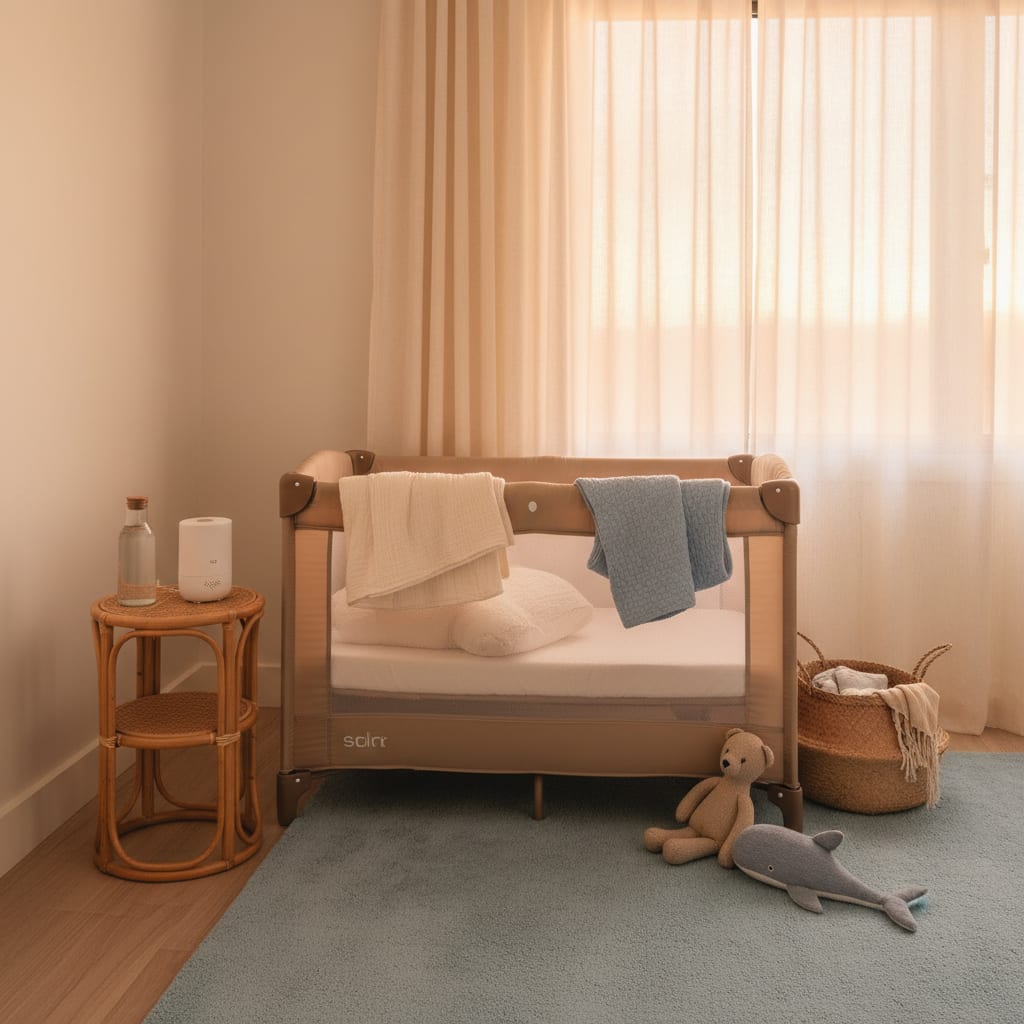
- A consistent sleep surface. A good travel crib, such as the Guava Lotus, that you’ve practiced in at home — do two or three home naps in it before the trip so it smells and feels familiar — or a confirmed hotel crib.
- The routine itself. Ours compresses to: feed, bath or wipe-down, sleep sack, one book, same song, lights out. Fifteen minutes, performable in any room on earth.
The broader gear question — what earns suitcase space and what doesn’t — is covered in my travel essentials list.
Time zones: the honest playbook
For one or two zones, don’t adjust at all — keep home time and enjoy the weirdly civilized late mornings. For three or more:
- Shift to local time on arrival — meals, naps, and bedtime at local hours, even if the first bedtime is a negotiation.
- Use daylight as the lever. Bright morning light outside pulls the body clock forward; dim, boring rooms at night push it back into place.
- Handle the 4am party correctly. Boring parent wins: low light, minimal talk, feed if needed, back down. It typically fades within two to four nights.
- Expect eastbound to be harder than westbound, and pad the first days of the itinerary accordingly.
Where this gets genuinely easier with Betteroo: the app builds your baby’s sleep plan around their actual age, sleep needs, and schedule — and when we told it we were flying from the East Coast to Hawaii, it rebuilt the nap-and-bedtime plan for the transition days instead of leaving us to spreadsheet it ourselves at 5am. That adaptive piece is what sold me; generic printable schedules can’t follow you across six time zones. If you want to see what it would recommend for your baby, the two-minute sleep quiz is the front door.
A balanced note, because I promised honesty: no app makes jet lag disappear, ours included the rough second night in Hawaii where all parties were awake at 3:40am admiring the ceiling. What the plan did was compress the chaos — clear answers for “when should the nap be today?” — so we adjusted in days, not the whole trip. Tool, not magic wand.

Naps on the move
Perfect crib naps every day of a vacation is a fantasy; aim for one anchor nap in the travel crib daily, and let the rest happen in motion — carrier, stroller, car. Motion naps are shorter and lighter, but they keep the baby solvent between anchor naps, and they let the family actually see the destination. On flight days, sleep rules are suspended entirely: whatever produces sleep on the plane is correct (the flying guide has the full cabin playbook).
When the wheels come off
Some nights fail anyway — a fire alarm, a molar, a crib the baby regards as a betrayal. The recovery plan: don’t abandon the system over one bad night, run the same routine again tomorrow, and front-load easier days after travel days. Babies re-find their rhythm fast when the cues stay consistent; it’s the constant rule-changing that prolongs the chaos. And if travel has exposed a sleep foundation that was shaky at home too, that’s worth solving before the next trip — timing trips into the easier sleep windows helps, as does building the jet-lag plan into the booking itself rather than improvising on arrival.
FAQ: baby sleep and travel
How do I get my baby to sleep in a hotel room?
Rebuild the familiar cues: their own sleep sack, white noise, genuine darkness, and the exact home wind-down routine. Set the crib up in the darkest corner (or the bathroom-adjacent nook — no shame, all veterans do it) and run the first bedtime early, not late.
Should I keep my baby on home time or local time?
One or two zones: stay on home time. Three or more: switch to local time from the first morning and use daylight to drag the body clock along. Most babies adjust within two to four nights.
Does a sleep app like Betteroo actually help with travel?
A personalized one can — the value is having the plan recalculated for your baby’s age and the specific time change rather than guessing. We use Betteroo because its plan adapts on the road; start with the sleep quiz and it builds the schedule from your baby’s actual sleep data, travel days included.
Will one trip ruin my baby’s sleep training?
No. A week of looser sleep doesn’t erase months of good habits — babies snap back remarkably fast once the familiar rules resume at home. Expect two or three recalibration nights after you return and call it the cost of a life well-traveled.