Best Travel Crib: What Baby Actually Sleeps In
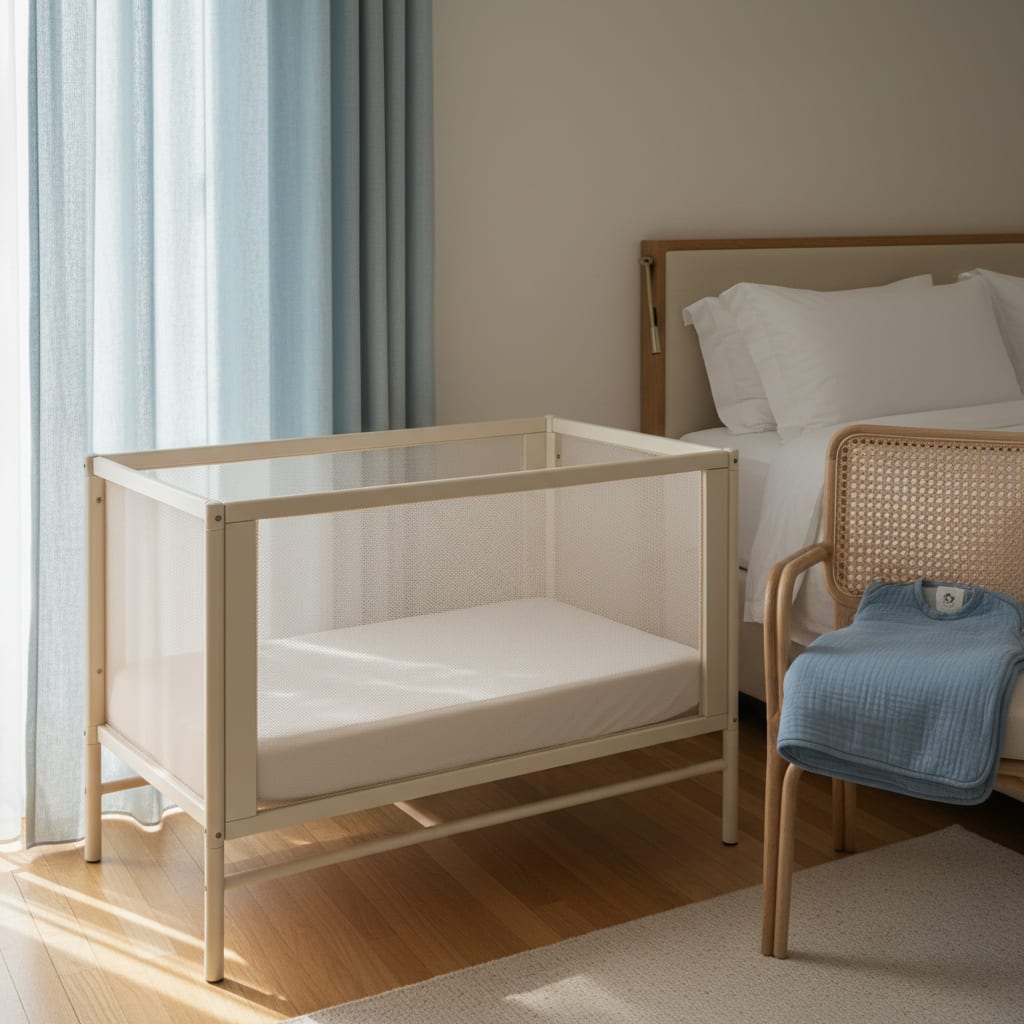
The best travel crib for most families is the Guava Lotus: it carries as a backpack, sets up in well under a minute, and has a zippered side door that lets you settle a baby without lifting them over a rail. It’s around 15 pounds, GreenGuard Gold certified, and the only one on this list I’ve never resented carrying. Below: the shortlist, the honest case for the hotel cot, and the thing that matters more than any of it.
If you buy through links on this page we may earn a commission, at no extra cost to you. Nobody tells us what to recommend.
What makes a travel crib worth carrying
- A firm, flat sleep surface. This is the safe-sleep baseline and it’s non-negotiable: a firm, flat mattress, a fitted sheet, nothing else in the crib. Never add a topper or a folded blanket to “make it softer.”
- Carry format over raw weight. A 15-pound backpack beats a 12-pound duffel every time, because your hands are already full.
- Setup you can do in the dark. You will be assembling this in a dim hotel room with a tired baby on the bed.
- A footprint that fits a hotel bathroom or a walk-in wardrobe. Getting the crib out of your light and noise is half of surviving one room.
- Washable everything. Travel nights are messy nights.
The picks
Guava Lotus — the one I keep buying
Backpack straps, a genuine 15-second setup once you’ve done it twice, and a fold that fits in an overhead bin. The side door is the feature nobody thinks they need and everyone uses: you can lie next to the crib on the floor and pat a baby back to sleep without the lift-over that wakes them. It’s also the most expensive here by some margin.
BabyBjörn Travel Crib Light — the easiest fold
Around six kilos, suitable from birth to roughly three years, and the fold is one motion — the crib collapses into its bag rather than being wrestled into it. The Travel Crib Light has the softest included mattress of the group and the fewest fabric folds to catch a small limb. No side door, and it takes more floor space than the Lotus.
phil&teds Traveller — the smallest packed size
The Traveller is the lightest thing here at roughly seven pounds, with a self-inflating insulated mattress and a mesh-and-aluminium build that packs down to something you can genuinely hand-carry with a second bag. Two caveats: it sits low to the ground, which older backs feel, and the insulated mattress matters more than it sounds on a tiled floor or a cold rental cottage.
Graco Pack ‘n Play Day2Dream — the budget option
A Pack ‘n Play is not really a travel crib. It’s heavy, it’s bulky, and folding it correctly is a skill. But it’s a third of the price, it’s what half the grandparents in America already own, and if your trips are road trips with a car boot, none of the objections apply.
SlumberPod — the accessory that outperforms the crib
Not a crib at all: a SlumberPod is a blackout canopy that goes over a travel crib or playard, blocking the great majority of light and giving your baby a dark, private space in a room you’re all sharing. It’s rated from around four months, and the maker’s ventilation and fan guidance is worth reading properly rather than skimming. On a one-room trip it does more for sleep than upgrading the crib would.
Darkness beats the mattress
Here’s what four years of hotel rooms taught me: babies will sleep on a perfectly ordinary travel mattress in a dark, quiet, familiar-smelling space, and will not sleep on a lovely one in a bright room with a corridor outside. If you’re spending money, spend it in this order — blackout, white noise, then crib.
That’s also why a baby who sleeps fine at home can suddenly refuse a travel crib entirely. Usually it isn’t the crib; it’s the light, the room-sharing, and the fact that nothing smells right. If the refusal predates the trip, though, that’s a different problem — a baby who won’t settle in the crib at home needs fixing before you add a time zone to it.
The rest of my portable setup — sleep sack, sound machine, the routine that runs in the same order everywhere — is in baby sleep while traveling.
Should you just use the hotel cot?
Sometimes, genuinely, yes. Hotel cots are free, they’re already in the room, and mid-range and upmarket hotels usually have decent ones. Ask three questions when you book: is there a mattress and a fitted sheet, what condition is it in, and can it be in the room before you arrive rather than delivered at 10pm.
The case for bringing your own is consistency. The same crib, the same sheet, the same smell in Lisbon and Lima is a meaningful sleep cue for a baby who has very few other reference points. If you’re travelling twice a year, borrow the hotel cot. If you’re travelling every couple of months, buy your own.

Making the first night work
Set the crib up the moment you get in the room, before dinner, before anything. Let your baby crawl in and out of it in daylight — twenty minutes of playing in a new crib buys you a much shorter settle at 7pm. Put it in the darkest corner, away from the door and the corridor noise, and run white noise loud enough to cover a lift and a hallway conversation.
Then expect night one to be worse than night three, because it always is. The full one-room playbook, including where to put the crib when the room is genuinely tiny, is in getting a baby to sleep in a hotel room.
FAQ: travel cribs
What age can a baby use a travel crib?
Most are rated from birth to around three years, though the top end depends on whether your child can climb out. Check the specific model, and stop using it the moment climbing starts.
Can I add a mattress topper to make it softer?
No. Safe sleep means a firm, flat surface with a fitted sheet and nothing else. A softer surface is exactly the risk the guidance exists to prevent.
Do travel cribs fit in an overhead bin?
The compact ones — the Lotus, the Traveller — usually do on mainline aircraft. A Pack ‘n Play does not. Everything checks free as baby equipment on the major US carriers regardless.
Is a SlumberPod worth it if I already have a travel crib?
If you’re sharing a room, probably yes. It solves light and privacy, which are the two things that actually break travel sleep, and it packs smaller than the crib does.
What should I pack to go with it?
Two fitted sheets, a sleep sack your baby already knows, white noise, and a portable blackout solution. That short list is doing most of the work — the rest is in the baby travel packing list.