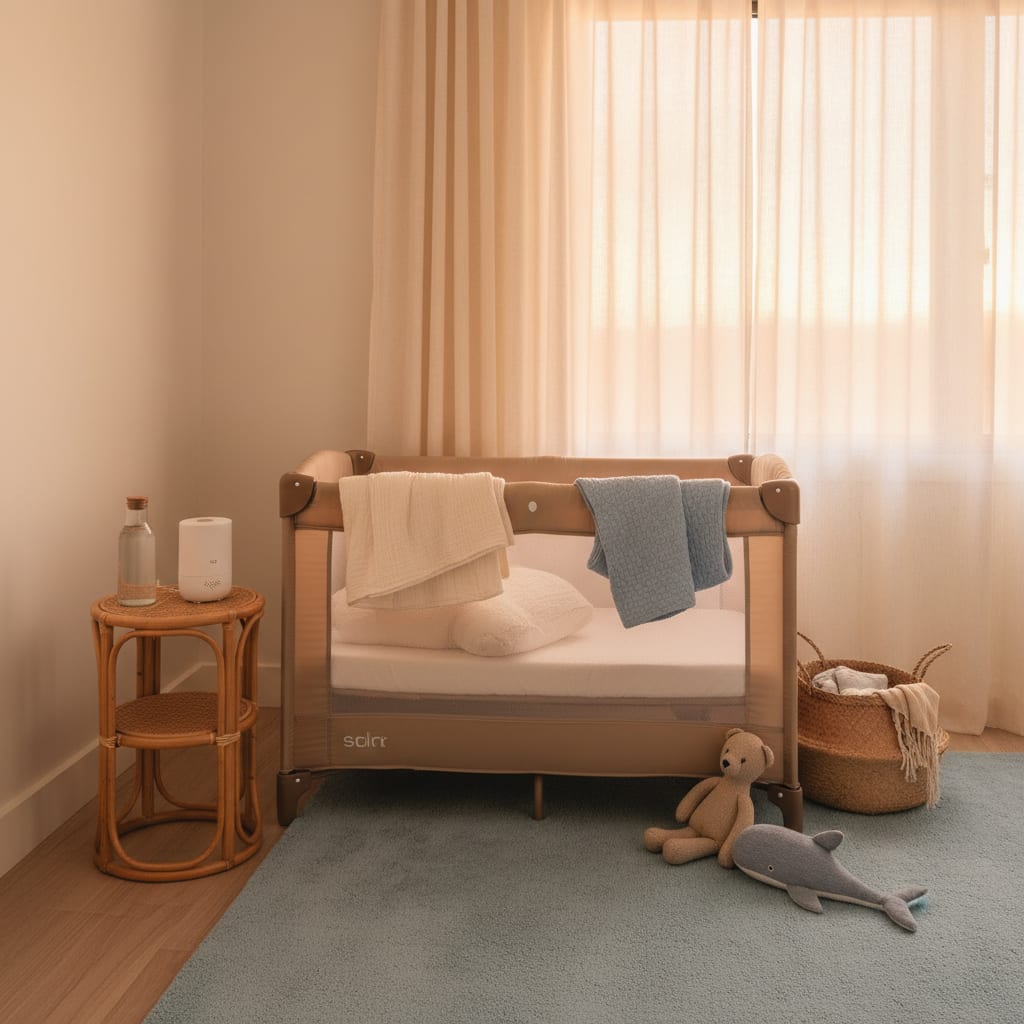
Baby Won't Sleep After Vacation: The First Week Back
If your baby slept well on holiday and badly the moment you walked back through your own front door, nothing has gone wrong and nothing has been undone. The week home is harder than the trip for three ordinary reasons: a sleep debt the holiday was hiding, one or two settling habits that were borrowed for the week and never handed back, and a familiar room that now has to compete with a fortnight of novelty. Hold your normal wake time, rebuild the bedtime sequence exactly as it was, and unpick the borrowed habits one at a time. Most families are through it in three to seven nights.
Why away was easier than home — it wasn’t luck
Parents describe this as a cruel joke: two weeks of sleeping through in a rented room with paper-thin walls, then four nights of screaming in the cot they’ve used since birth. A holiday quietly stacks the deck in favour of sleep, in ways that end the day you come home.
The day was physically bigger. More daylight, more outside, more wind and water and unfamiliar noise to process. A child who spent the day on a beach goes to bed differently from one who spent it in the living room.
You were more consistent than you are at home, not less. This is the one that surprises people. In one room with nowhere to hide, most families run an identical bedtime every single night. At home there is a bath that gets skipped, a sibling pickup, a work call, a guest. The holiday routine was rigid because the room forced it to be.
You answered instantly. Sleeping within arm’s reach means a stir gets met before it becomes a wake-up. That is genuinely calming — and it is also a habit, which is where the week back comes from.
What actually breaks when you get home
The sleep debt arrives late
Holidays run on later bedtimes, shorter naps in odd places, and adrenaline. Children carry that for a while, then present the bill: a lovely last few nights away, then a child who is wired, tearful and fighting bedtime by day two at home. It reads as protest and is usually exhaustion — and an overtired child sleeps worse, not more.
One or two borrowed habits came home in the luggage
Everyone borrows something: naps in the carrier or the car, a feed to sleep because the room was small, a parent on the floor beside the travel cot, bedtime an hour late because dinner was at eight. On holiday those are sensible. At home they collide with a child who has an actual cot, an actual dark room, and a parent who would like their evening back. That collision is what you are hearing at 7:30pm.
The room is the same and the child isn’t
Nothing about your house changed. Your baby did — a fortnight of stimulation, sometimes a developmental step, often a nap that quietly dropped while you were away.
And if you crossed time zones, that’s a separate problem
A clock problem looks different: the same wrong time every night, a bedtime that has migrated by hours rather than minutes, a 4am start that repeats precisely. If that is what you have, the fix is light timing rather than habit, and baby jet lag handles it properly. If the trip itself wrecked the schedule on the way — hours of car sleep displacing the day, arriving at midnight — follow road trip sleep reset instead. This post is for the trip that went well.
The seven days back
Arrival day: land, then stop
Get home in daylight if the timetable gives you any choice; late arrivals cost you the following day too. Do nothing else, and put your child down twenty to thirty minutes early. Set the cot up exactly as it was before you left: same sheet, same sleeping bag, same sound, same order.
Days one and two: fix the wake time and nothing else
Wake your child at their normal home time even if the night was terrible, and take them straight into daylight. Everything else hangs off that fixed point, and letting them “catch up” with a 9am lie-in is the commonest way families stretch this week into a fortnight.
Put the first nap of the day in the cot at home, even if it is short and a stroller nap would be easier. The first nap back is the one that re-teaches the room.
Change nothing else yet — no moving them to a bed because they slept brilliantly in one on holiday, no repainting, no new comforter. You are trying to find out what the trip cost, and you cannot do that while adding variables.
Days three to five: hand back one borrowed habit
List what you borrowed. Most families find two or three: bedsharing, feeding to sleep, motion naps, a parent in the room, a much later bedtime. Rank them by what they cost you at home and take the most expensive one first, on its own, for three consecutive nights before touching the next.
Unwinding three at once turns a rough week into a rough month, and it destroys your evidence: change all of them on the same night and a bad night tells you nothing about which change caused it.
Days six and seven: is it still the trip?
By the end of the first week most of this has resolved. If it hasn’t, the holiday has probably stopped being the explanation. Look at age first: wake windows that were right a month ago may not be right now, and a genuine regression runs to its own timeline. Worth knowing how long a real one actually lasts before you assume you caused this with a week in Portugal.
The other candidates are illness — travel brings bugs home, and an ear infection shows up as night waking long before anything else — and a settled objection to the cot itself rather than to sleep, which is a different problem with a different fix.

What to do differently on the next trip
You cannot avoid borrowing habits on holiday and shouldn’t try — a week of contact naps is a fair price for a week that works. Borrow deliberately instead.
Carry the sequence, not the room: same order of events, same sound, same sleeping bag, wherever you are. That is the part that travels, and it is why some families come home to nothing at all — most of it is packed rather than bought, which is the argument in baby sleep while traveling.
Keep one thing untouched for the whole trip. If naps go feral, hold the bedtime routine; if bedtime goes late, hold the morning wake time. A single anchor gives you something to rebuild from — and it is why trips usually improve after a rocky start, as the second night away explains.
Then protect the day you get back: coming home a day early is the day that pays for the week.
FAQ: sleep after a holiday
How long does it take a baby to get back to normal after a vacation?
Usually three to seven nights if you hold the home wake time and rebuild the routine straight away. It stretches when families let mornings drift later to compensate for bad nights, or when several borrowed habits are unwound at the same time.
Why does my baby sleep better on holiday than at home?
Bigger, more physical days, much more daylight, and — the part nobody expects — a stricter bedtime than they get at home, because one room forces one routine. Sleeping within arm’s reach also means stirs get answered before they become wake-ups.
Should I let my baby catch up on sleep after a trip?
Yes, but at the front of the night rather than the back of the morning. Bring bedtime forward twenty to thirty minutes for a few nights and keep the wake time fixed. Late mornings feel like recovery and quietly push the whole day later.
Should we keep the travel cot up at home if they sleep in it?
For two or three nights as a bridge, yes. Longer and you own two sleep setups and the same argument later, so move the sleeping bag, the sound and the position in the room back to the cot instead.