Two Homes in Different Time Zones: A Kids' Sleep Plan

When a family keeps two homes in different time zones — co-parenting across a country, a second home, one parent posted abroad — the mistake is treating every move as a fresh jet-lag problem to solve from scratch. Repeated crossings never finish adjusting, so full adaptation at the far end is the wrong goal. Pick one anchor clock and keep it permanently, run the second home on a deliberate partial offset instead of a flip, and duplicate the sleep setup at both ends so the only thing that ever changes is the hour.
Why this isn’t jet lag, even though it feels identical
One-way jet lag has an endpoint. The rough rule of thumb is about a day of adjustment per hour of difference, so a three-hour gap needs roughly three days before a small child’s body stops arguing — and that is the version I walk through in toddler jet lag.
Now put that rule against a back-and-forth schedule. A Friday-evening handover and a Sunday-night return gives you two nights. A school-holiday fortnight gives you time to adapt and then hands the child straight back. Either way the adjustment never completes, and the next crossing starts from wherever the last one stalled.
That changes the objective. On a holiday you are getting your child onto local time. Here you are trying to stop them being dragged across three hours of body clock, forty times a year, with no arrival to recover into. The families who do this well have simply stopped trying to win it.
Pick the anchor clock once, then stop relitigating it
One home runs the child’s real schedule. The other measures itself against it. This is the whole system, and the argument about which is which is worth having once, calmly, in advance.
The anchor is whichever home carries the fixed obligations — the school start, the nursery drop-off, the parent whose shift begins at seven. It is not necessarily the home with more nights, and it is not necessarily the one anyone thinks of as “home”. A schedule that works everywhere except Monday morning does not work.
If neither home is fixed — both children under school age, both parents flexible — anchor to the home whose mornings are least forgiving. A body clock left running late makes early mornings genuinely miserable, and an unforgiving morning is the thing that turns a manageable mismatch into a crisis by Wednesday.
Write the anchor down somewhere both households can see it. In separated families especially, this is where a sleep plan quietly becomes a negotiation, and a decision made in advance is far easier to hold than one made at nine on a Sunday night.
How far to shift at the second home
Not all the way. The offset I have seen hold up best is roughly half the difference, capped at about two hours, held for the entire stay.
- One zone: do not shift at all. Relabel the clock and carry on. One hour is small enough to absorb and awkward enough to make a mess of, which is its own whole problem — see the one-hour time difference.
- Two or three zones: shift about half of it. A three-hour gap becomes a 90-minute compromise: bedtime looks late at the eastern home and early at the western one, and neither is a disaster.
- Four or more zones: take the two-hour cap and accept that bedtime will look strange to anyone watching. You are buying a repeatable schedule, not a normal-looking one.
- Stays longer than about ten nights: the exception. Flip fully to local time on the first morning — the stay is long enough to complete an adjustment, and long enough that a permanent mismatch costs more than the transition would.
Move the wake time, not bedtime. Bedtime follows a held wake time far more reliably than the reverse, and a wake time can actually be enforced with light and noise. A bedtime is a negotiation with a tired person.
Make the two bedrooms into one room
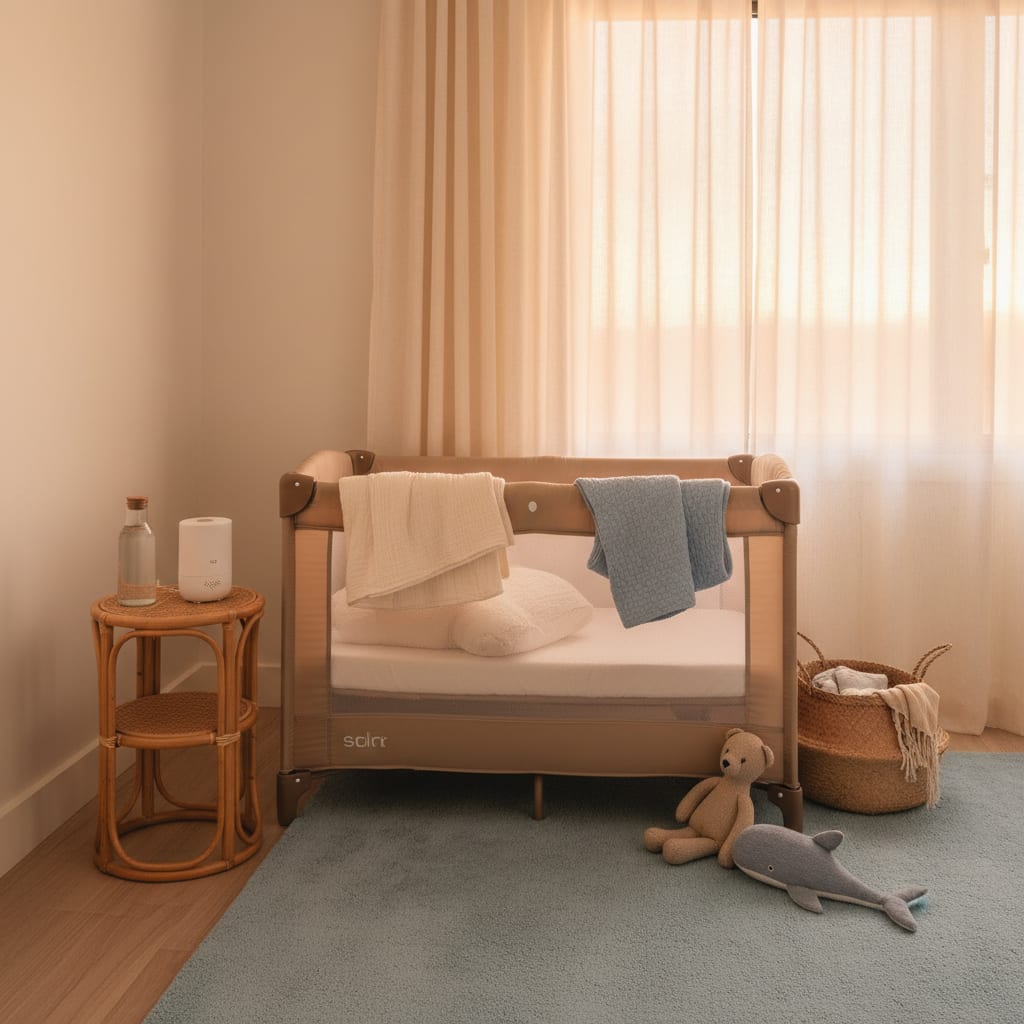
Here is the lever almost nobody pulls, and it is available to you precisely because this is repeating rather than one-off: duplicate the sleep environment at both ends until it is the same room in two places. Same white-noise sound at the same volume, same darkness, same cot sheet, same soft toy, same order of the same routine.
Buy two of everything rather than shuttling one set. The shuttled set gets left behind at exactly the wrong moment, and rummaging through a bag is not a bedtime routine. Darkness usually needs the most work, because two homes at different longitudes get their sunsets at different local hours; the placement-and-blackout thinking in my hotel room sleep guide transfers straight to a spare bedroom that is dark enough for August but not for June.
The payoff is diagnostic, not just comfortable. On an ordinary trip the room and the clock change together, which is why the second night away is so hard to read: you cannot tell which one broke. Engineer the room out of the equation and every bad night has exactly one suspect left.
Give the handover day to the receiving home
Whoever the child is arriving to owns the reset. The sending parent’s only job is a genuinely full night before the journey — not a plan to run them ragged so they sleep on the plane.
Travelling east — losing hours, arriving into a later clock — means stretching the day. Get them into daylight on arrival, keep the afternoon moving, refuse any crash nap after mid-afternoon, and put bedtime half an hour before the offset time rather than at it. Nobody will be tired; that is normal and it passes.
Travelling west — gaining hours, arriving into an earlier clock — gives you a long, strange evening and a child who wants to sleep at what the local clock calls five. Late-afternoon light is the tool, dinner sits later than feels right, and anything before about five in the morning is treated as night: dim, boring, no talking. Early waking is the price of westbound travel, and it fades in a day or two if you refuse to start the day on it.
When the split stops working
Two signals mean the time zones have stopped being the problem.
The first is night wakings that show up at both homes, at the same body-clock hour. Geography cannot cause that. That is a habit that has formed around a wake-up, and it needs the ordinary at-home approach rather than a schedule tweak — Betteroo’s walkthrough of why a toddler keeps waking in the night is the right starting point.
The second is a schedule that no longer fits the child’s age. Offsets get set once and quietly outlive the nap they were built around: a two-hour compromise that made sense at eighteen months is nonsense once the nap has gone. Re-derive the anchor schedule from your child’s current age about twice a year, then rebuild the offset from it. Running a schedule you can state precisely is what makes this workable at all: you cannot offset a schedule you are improvising.
FAQ
Should we just keep our child on one time zone permanently? For one zone, yes. For two or three it is worth trying if the stays are short, but it puts the visiting household on a schedule that fights local meals and daylight, and that tends to collapse. The half-difference offset is the sustainable version of the same idea.
Do we need to pre-shift before every handover? No. Pre-shifting is for one-way trips with a long stay at the far end. Doing it before every crossing means the child is being moved twice as often, which is the exact thing this plan exists to prevent.
Does the number of hours matter more than the direction? The hours set how big the problem is; the direction sets what it feels like. Eastbound gives you a child who will not fall asleep, westbound a child who is up before dawn. Most families find westbound easier to live with — a reasonable tiebreaker when you get to pick flight times.
What about school-age kids and Monday mornings? Anchor to the school home and protect Sunday night above everything else. A late Sunday return is worth swapping for an earlier one even if it costs a few hours of the weekend, because the whole week is downstream of it.