Car Seat on a Plane: FAA Rules Made Simple
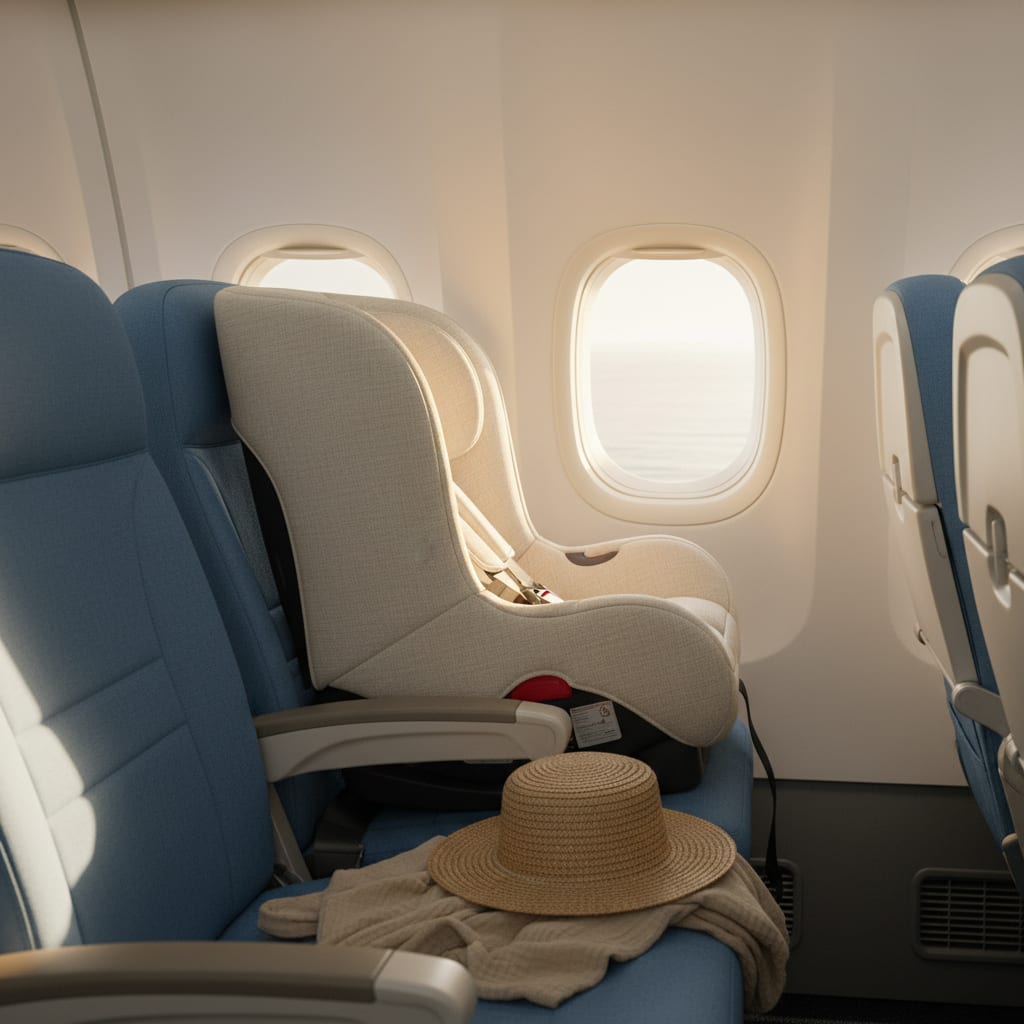
You can bring a car seat on a plane if it carries a label reading “This restraint is certified for use in motor vehicles and aircraft,” your child has a purchased seat, and the seat goes in a window position that doesn’t block anyone’s exit. That’s the whole rule. Everything else — the width worries, the gate-check gamble, the boarding-door argument — is airline detail layered on top. Here’s the FAA line, what airlines add to it, and the decisions I actually make at the counter.
The label decides everything
Turn the seat over and read the stickers. US-made child restraints that are approved for aircraft carry the sentence “This restraint is certified for use in motor vehicles and aircraft,” usually in red. If it’s there, the seat is legal to install on a US carrier. If it isn’t, no amount of arguing at the gate will change that.
Seats approved by a foreign government carry their own markings instead, which is why an EU-bought seat can be fine on a US flight and a US seat can raise eyebrows abroad. If you’re flying with a seat you bought overseas, photograph the label before you go.
The FAA is not neutral about this, either. It strongly discourages holding a child on your lap and recommends that children under two ride in an approved restraint — the safety argument I go through in detail in flying with a lap infant.
Where the seat has to go
A hard-backed seat has to be installed somewhere that doesn’t block another passenger’s path to the aisle. In practice that means the window seat, every time, and never an exit row. On a three-across row, the middle is occasionally allowed if the window seat is empty or occupied by your own family; ask, don’t assume.
Airlines can restrict which positions work on which aircraft — bulkhead rows and some premium seats with fixed shells are common exclusions. The upside: if your approved seat genuinely won’t fit where you’re sitting, the airline is responsible for finding you another seat in the same class of service. That’s a right worth knowing about, calmly, at the gate.
What isn’t allowed during taxi, takeoff and landing
Three categories get turned away, and it catches families out every single trip:
- Backless boosters. A booster needs a lap-and-shoulder belt to do its job. Airplanes have lap belts only, so backless boosters can’t be used for taxi, takeoff or landing. Pack it for the rental car and stow it overhead in flight.
- Baby carriers and slings. Lovely for the terminal, not a restraint. Baby comes out for takeoff.
- Aftermarket harness gadgets. The bargain “airplane safety harness” listings are mostly not FAA-approved, and cabin crew are trained to spot them.
The one harness-type exception is below, and it’s the reason a lot of families stop lugging a seat entirely.
The CARES harness: one pound, one exception
CARES is the only harness-type device the FAA has approved. It’s a webbing loop that goes around the seat back and buckles into the existing lap belt, certified for children roughly 22–44 pounds and up to about 40 inches tall — so, most kids from around a year old until they’re big enough for the regular belt alone.
It weighs about a pound, stuffs into a small bag, and installs in a minute or two. What it does not do is help you in the rental car at the other end, and it does not contain a squirmy toddler the way a five-point car seat does. For long-haul flights where the goal is sleep, a real seat still wins. For a two-hour hop where you’ve pre-booked a car with a seat, CARES is the better bag.
Buy it from the manufacturer or a reputable seller — counterfeits exist, and the FAA has said so.
Will it fit? The width question
Most airlines publish a guideline of roughly 16 inches for seat width, which the majority of narrow convertibles clear comfortably. Measure yours at its widest point, which is usually the cup holders (pop them off if they’re removable — that alone rescues a lot of seats).
The bigger gotcha is depth, not width. Rear-facing installs eat legroom, and on a tight-pitch economy row a large convertible rear-facing can end up pressing into the seat in front. If you’re rear-facing a bigger kid, a compact travel-specific seat is worth the money; I’ve sorted the options in best travel car seat.
Bring it, check it, or rent it
Bring it on board when your child has a purchased seat and you want them contained and asleep. This is my default for anything over three hours.
Gate-check it when you’re flying with a lap infant and still need the seat at the destination. Car seats and strollers check free on the major US carriers, and gate-checking keeps the seat with you until the jet bridge. It also means the seat rides in the belly with the suitcases, so a padded travel bag is a sensible $40.
Rent one only when you’ve confirmed the details in writing. Rental-counter seats are a lottery: unknown history, sometimes expired, occasionally missing the manual. If you go this route, inspect it before you drive off and be willing to walk away.
For the ticketing side of all this — when the second birthday changes your options and why buying the seat is usually worth it — see flying with a 2-year-old.
FAQ: car seats on planes
Do I have to buy a seat to bring a car seat on board?
Yes. A child restraint can only be installed in a purchased seat. If your under-two is ticketed as a lap infant, the car seat rides in the hold or at the gate — unless the flight is light and a crew member offers you an empty seat, which does happen and is worth asking about at boarding.
Is my convertible car seat FAA approved?
Check the label for “certified for use in motor vehicles and aircraft.” Nearly all US convertible seats carry it; most backless boosters do not.
Can I use a car seat in the bulkhead row?
Often no. Bulkhead rows have no seat in front to brace against and some have fixed armrests or inflatable belts that complicate installation. Ask when you book rather than at the door.
Does the car seat count as carry-on baggage?
No. A car seat used in a purchased seat doesn’t count against your carry-on allowance, and gate-checking one is free on the major US airlines. Strollers are treated the same way.
What if the crew says my seat can’t be used?
Ask which part of the rule it fails — label, position, or fit. If it’s fit, the airline should reseat you in the same class. If it’s the label, they’re right and the seat goes below.