Vacation Rental Noise: When the Elevator Is Behind the Wall
You cannot soundproof a rented apartment in a week, so don’t try. Move the sleeper instead: work out which room shares a wall with the elevator shaft or the stairs, put your child in the other one, and get the crib as far from that wall as the furniture allows. Then mask what’s left with steady sound rather than hunting for silence, block the gap under the front door, and treat the first night as unrepresentative. Structural noise is a layout problem, not a settling problem — and the layout is the part you can still change.
Why building noise is different from street noise
A busy street is loud and boring. It hums, it never stops, and small children sleep through it beautifully — which is why a room over a main road often goes better than the listing photos suggest.
An elevator shaft and a stairwell are the opposite. The noise is intermittent, and it arrives through the building rather than through the air: the motor starting and stopping, a fire door on a spring closer letting go with a bang, feet on concrete stairs, a hard-shell suitcase dragged across a landing at half past eleven. Curtains and rugs do very little to any of it, because none of it is coming in through the window.
What wakes a child is the pattern rather than the volume — quiet, bang, quiet. And in a holiday building it peaks at the worst possible hours, because the other guests are arriving late and leaving early. Bedtime and the five a.m. stretch are the two busiest periods on that staircase all day.
Find the shaft before you unpack
Do this in the first ten minutes, before anyone is tired.
Walk the corridor first. Note where the elevator doors and the fire door to the stairs are, then stand in your own hallway and work out which of your walls back onto them.
Put a hand flat on each bedroom wall while somebody rides the elevator up and down once. Two minutes settles it better than guessing; structure-borne noise is often easier to feel than to hear.
Look for the giveaways. A windowless bedroom is frequently the one built against the core, a shallow boxed-in column in a corner is a riser, and a wall that sounds hollow when you knock will pass everything.
Check your own front door. In a one-bedroom rental the loudest object in the place is often a heavy fire door on a self-closer, a metre from where the crib was going.
Move the child, not the sound
Swap rooms. If one bedroom is quieter, the adults take the noisy one. This is the highest-value thing you will do all week, and the one people resist, because the quiet room is usually the small one. Take it anyway.
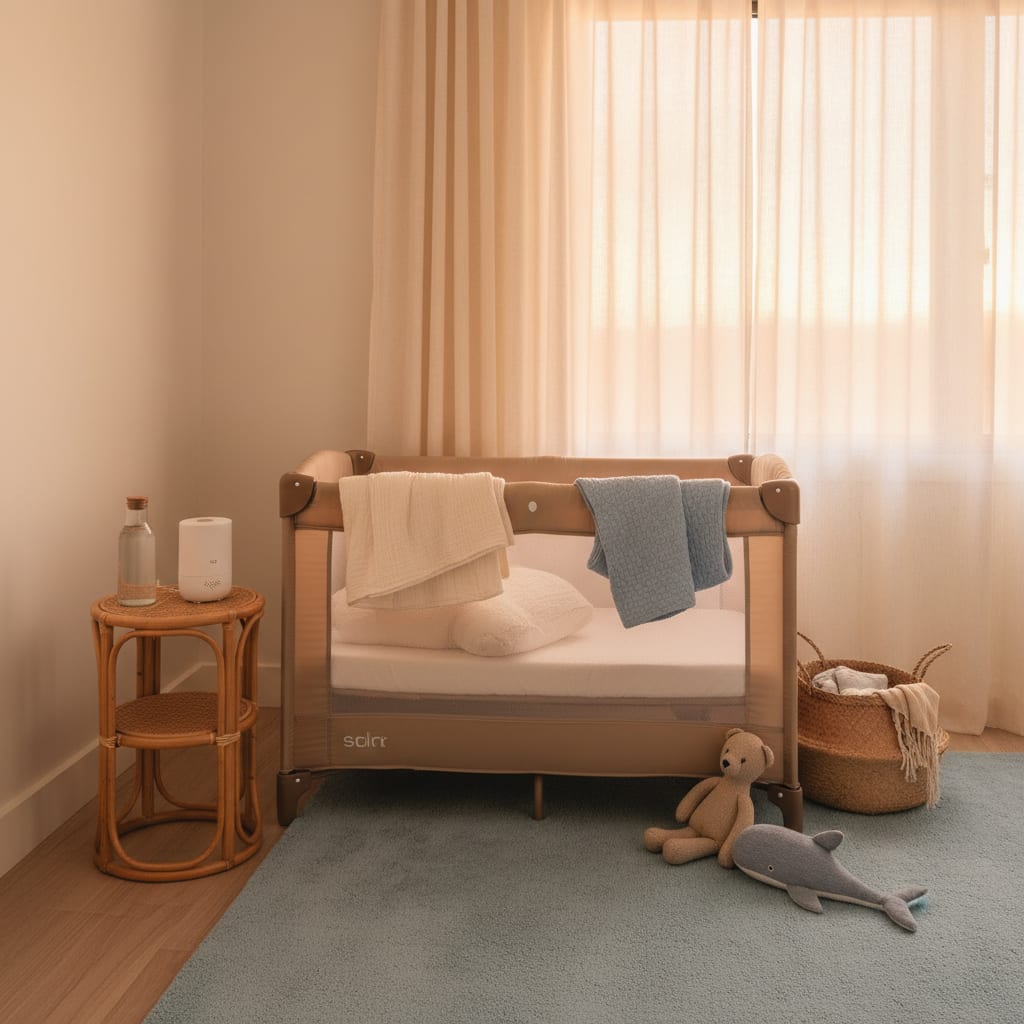
If there is only one bedroom, look at the living room. It is often further from the core, and a travel crib on a flat floor with its own firm mattress and nothing else in it is a legitimate place to sleep. My travel crib roundup covers the ones that actually pack down.
Use distance and mass inside the room. Get the crib to the far wall, and if a wardrobe or sofa can be shifted between it and the noisy wall, shift it — a loaded piece of furniture against a party wall makes a real if modest difference and costs nothing. Keep the crib out from under any window opening onto an internal light well, which funnels stairwell noise straight up to the glass.
Masking what you cannot move away from
Steady sound does not cancel a door slam. It raises the noise floor, so the gap between the quiet room and the bang is smaller and the bang is less of a jolt. That is the whole mechanism, and it is enough.
Put the source between your child and the noise — near the shared wall, not beside the crib — and keep it at a conversational level. The guidance worth reading before you turn anything up is Betteroo’s explainer on what white noise is actually doing.
The free version is already in the apartment: the bathroom extractor fan with the door ajar, or the air conditioning switched from auto to continuous fan so it hums instead of cycling. The packable version is a small battery machine — the Yogasleep Rohm is palm-sized, runs on its own battery and has one dial. A phone on a loop is not a substitute: it lights up, runs down, and stops at the exact moment the lift arrives.
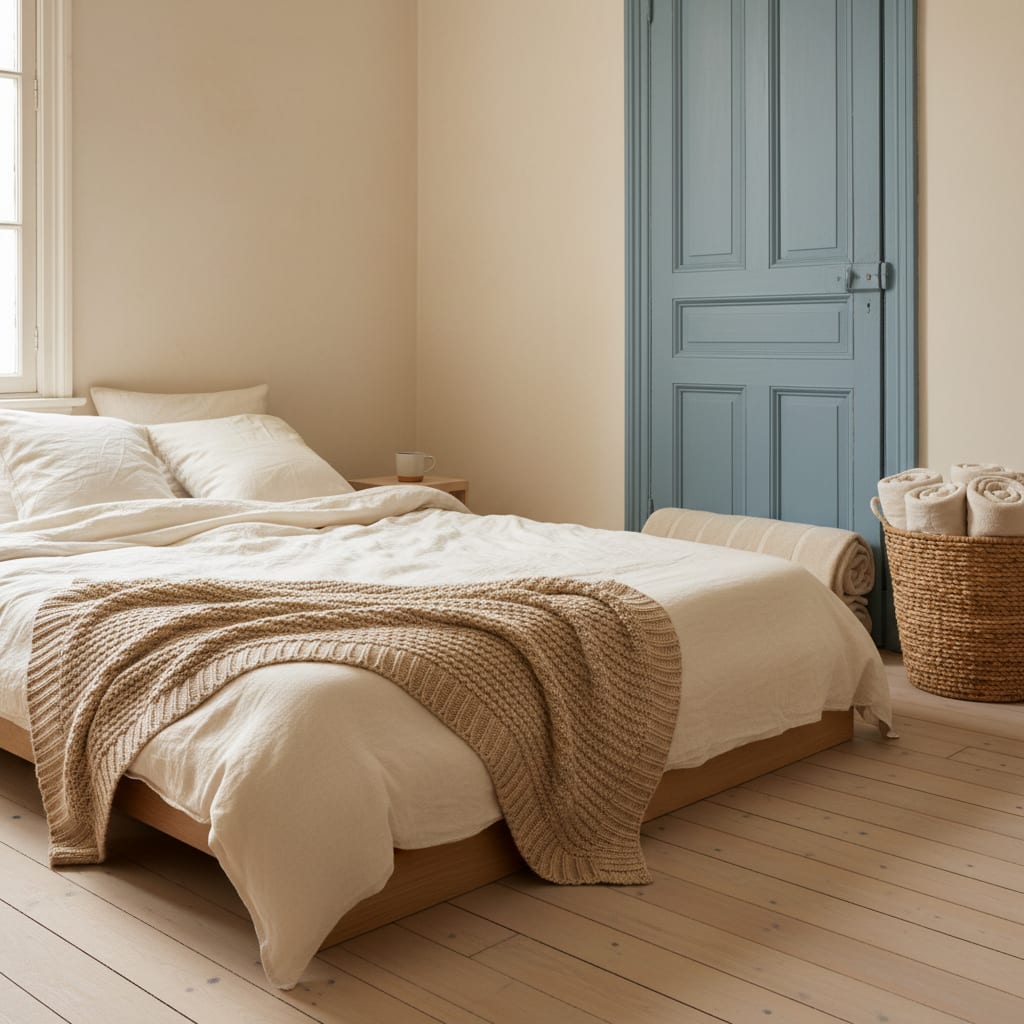
Do the free fixes too: a rolled bath towel along the base of the front door kills a surprising amount of corridor noise as well as the light strip, and clothes pegs clip the curtain gap shut.
What to ask before you book
Listings almost never mention this and guests almost always do. Read the reviews for elevator, lift, stairs and noisy first — one sentence from a previous guest beats every photograph on the page.
Then ask the host two direct questions: which floor is it on, and does it share a wall with the elevator or the stairwell? Hosts answer honestly more often than you would expect, because the alternative is a bad review. Where you have a choice, an end-of-corridor unit beats one facing the elevator lobby.
This is also a live argument in the bigger booking question, since a resort room is acoustically simpler than an apartment in a residential building — my all-inclusive versus vacation rental comparison weighs that against the kitchen and the door that closes. If you are still choosing the destination rather than the building, Betteroo’s roundup of where to go with a baby or toddler is a sensible starting point.
Night one is not the verdict
The first night often goes better than it has any right to, because travel-day exhaustion is doing the work. The honest night is the second, for the reasons in why the second night away is worse — so a rough night two is the normal shape of a trip, not proof the building has beaten you.
Change one thing at a time: move the crib, add masking sound and pull bedtime forward on the same evening and you learn nothing about which helped.
And check that it is the noise at all. If your child is waking at the same clock times as at home, or at times that track a time change, the elevator is a bystander — that is a schedule problem, and my hotel room sleep guide applies more than anything here does.

FAQ: sleeping in a noisy holiday apartment
Should I ask to move to a different apartment?
Yes, and ask on the first morning rather than the last — agencies with more than one unit in a building can often move you, and the request is far easier to grant early in a stay. Be specific: “the elevator is behind the bedroom wall” gets a better response than “it’s noisy”.
Does the sound machine need to run all night?
Running it continuously is simpler than timing it, because the point is to hold the noise floor steady. A machine that switches off after an hour leaves your child in a silent room for the busiest part of the evening. Keep it low and constant.
Is it safe to put the travel crib in the living room?
The room matters less than the surface: the crib needs its own firm flat mattress, nothing loose inside it, level ground and clear space around it, exactly as at home. What a living room adds is that somebody has to stay out of it once your child is asleep — worth thinking through before bedtime rather than at it.
Do earplugs help?
Not for young children; they are a choking risk and they do not stay in. For the adults sharing the room they can be the difference between one broken night and five, as long as one parent stays uncovered.
Will they get used to it by the end of the week?
Often, partly. Children do habituate to a repeating sound, and by night three or four a lift usually costs you a stir rather than a wake-up. What they habituate to badly is noise that only happens sometimes — so a stairwell shared with six apartments stays disruptive longer than a lift that runs constantly.