Flying With a Lap Infant: Rules, Fees and Regrets

A lap infant is a child under two who travels held by an adult rather than in a purchased seat — free on most US domestic flights, but rarely free internationally, where the standard structure is a percentage of the adult fare plus taxes. They still need to be added to the booking, they still need proof of age, and only one lap infant is allowed per adult. Here’s what the rules actually require, what it costs, what a bassinet really gets you, and the four things families most often wish they’d done differently.
The rules, in plain terms
The age line is the second birthday. Under two, a lap infant is permitted. On the day they turn two they need a purchased seat — and airlines check the return leg, so a trip that spans the birthday needs a seat booked for the way home.
They must be on the reservation. A lap infant is not automatic and often can’t be added online. Call the airline, get it in the record, and expect to be issued a boarding document for the baby even on a “free” domestic ticket. Turning up unannounced is the most common way to lose a seat assignment.
Bring proof of age. A birth certificate copy or the baby’s passport settles it at check-in. Under about six months this is rarely questioned; at 20 months it frequently is.
One per adult. The limit exists because each row carries a finite number of supplemental oxygen masks and infant belts. Twins on a lap are two adults’ work by regulation, not just in practice.
The FAA recommends against it. US regulators are explicit that the safest place for a child under two is in an approved child restraint in their own seat, and the turbulence argument is a genuinely serious one. The rules permit lap infants; the safety guidance does not endorse them.
What it costs
| What varies | Typical US domestic | Typical international | How to confirm |
|---|---|---|---|
| Base fare | Usually no fare | Commonly around 10% of the adult fare | Price the booking with the infant added |
| Taxes and fees | Minimal | Often the larger share of the total | Look at the fare breakdown, not the headline |
| Ticket issued | Boarding document | A real ticket with its own number | Ask for the infant’s ticket number |
| Bassinet | Rarely offered | Long-haul widebodies only | Request by phone at booking |
| Baggage allowance | Varies widely | Often a partial allowance | Check before you pack the second bag |
| Loop belt | Not used by US carriers | Common on many non-US airlines | Cabin crew will issue it if applicable |
Two practical notes. First, “free” domestic lap infants are usually genuinely free, so the money question mostly matters on international routes. Second, the fee is charged per flight segment, so a two-connection routing to Europe costs more in infant fees than a direct one — one more reason direct flights win with a baby.
Bassinets: worth chasing, easy to over-expect
Bassinets attach to the bulkhead wall on long-haul widebody aircraft. They are free, limited to a handful per cabin, and never guaranteed even when confirmed — an aircraft swap can erase yours the day of travel.
What they get you: somewhere to put the baby down for a few hours, and bulkhead legroom. What they don’t: use during taxi, takeoff, landing, or any turbulence, which on a rough night can mean the bassinet stays empty most of the flight. Most airlines cap use by weight and length rather than age, and a long six-month-old can outgrow one well before the limit date suggests.
Request it by phone the day you book, reconfirm at check-in, and hold it loosely.
The four regrets
1. Not buying the seat once the baby got mobile. Under about six months, lap travel is genuinely easy — they sleep on you and that’s the flight. Somewhere around eight or nine months, a lap infant becomes four hours of restraining someone strong, furious and fully awake. If your child is crawling and the flight is over about four hours, the seat is worth it. My guide to the easiest ages to travel with a baby breaks the windows down properly.
2. Booking the connection to save $90. Every extra segment is another boarding, another descent with ear pressure, another infant fee on international routes, and another chance for a delay to land you in a terminal at midnight with a baby who has run out of patience.
3. Not checking whether the aircraft has a changing table. Widebodies almost always do. Smaller regional jets often don’t, and discovering that mid-flight makes for a memorable diaper change on a closed toilet lid. Look up the aircraft type before you fly.
4. Packing for the flight instead of for the day. Delays, diversions and a bag that goes to the wrong city are all ordinary events. Pack the carry-on for a day and a half of feeding and changing, not for the scheduled flight time — the full list is in my international travel with a baby guide.
The one strategy worth knowing
If you’re two adults flying with a lap infant, book the aisle and the window and leave the middle seat empty. Middle seats fill last; on anything short of a full flight you may end up with a free extra seat, and if the flight does fill, the person assigned the middle will almost always trade for your aisle. It costs nothing and works often enough to be the default.
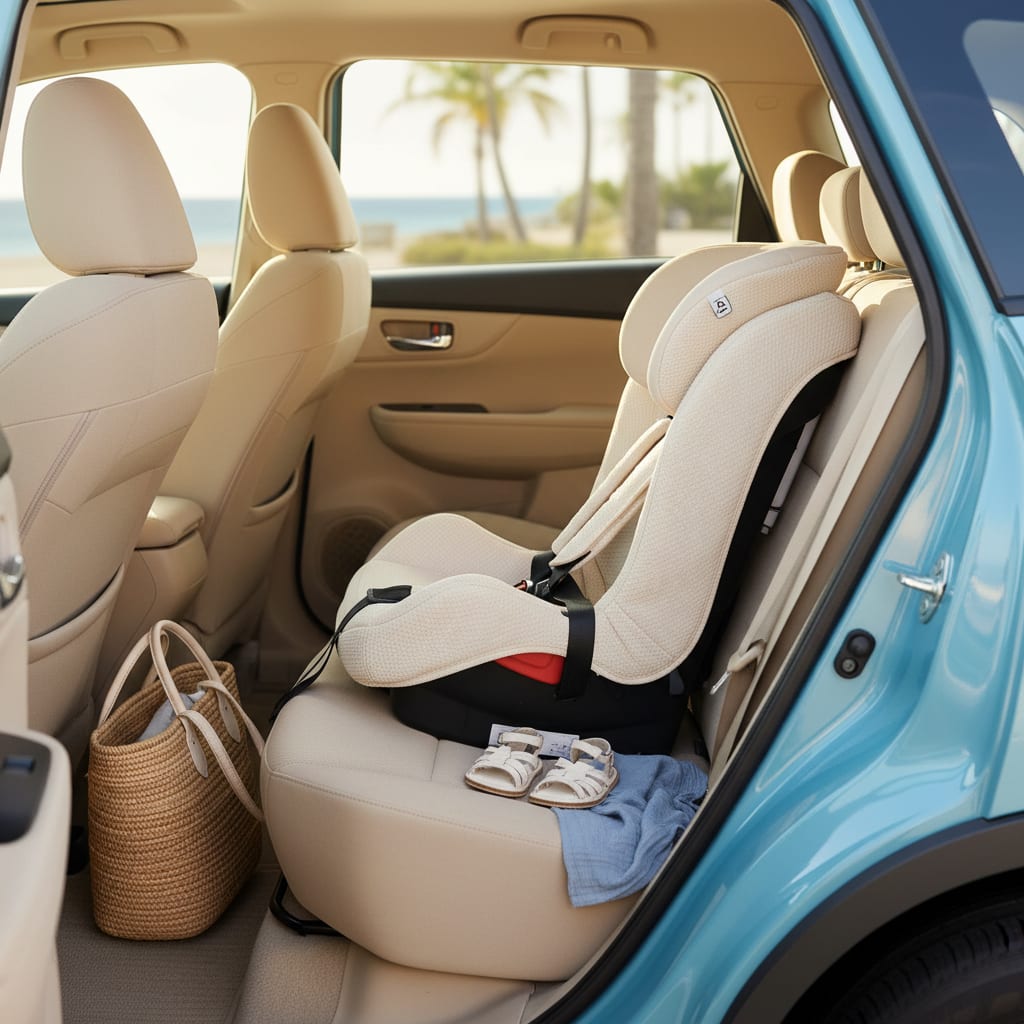
If it does stay empty and you brought an aircraft-approved car seat, you can install it and fly your baby the way the FAA would prefer — ask the gate agent whether the flight is full and whether you can bring the seat down the jetway.
FAQ: flying with a lap infant
How old can a lap infant be?
Up to their second birthday. After that a purchased seat is required, including on the return leg of a trip that began before the birthday.
Do lap infants fly free?
On most US domestic flights, yes. Internationally, expect to pay a percentage of the adult fare plus taxes — the taxes are frequently the bigger half.
Can a lap infant sit in a car seat if there’s a spare seat?
Yes, if the seat is certified for aircraft use and the row allows it. Ask at the gate whether the flight has empty seats before you gate-check the car seat.
Do I need a passport for a lap infant?
For international travel, yes — babies need their own passport, and some destinations require visas regardless of age. Domestically, a birth certificate copy is enough to prove age.
Is it worth buying a seat for a one-year-old?
Often, especially for flights over four hours. A mobile one-year-old on a lap is genuinely hard work, and the same trip with a familiar car seat is a different experience — the same logic that runs through flying with a toddler.