Your Toddler's First Flight: A Realistic Walkthrough
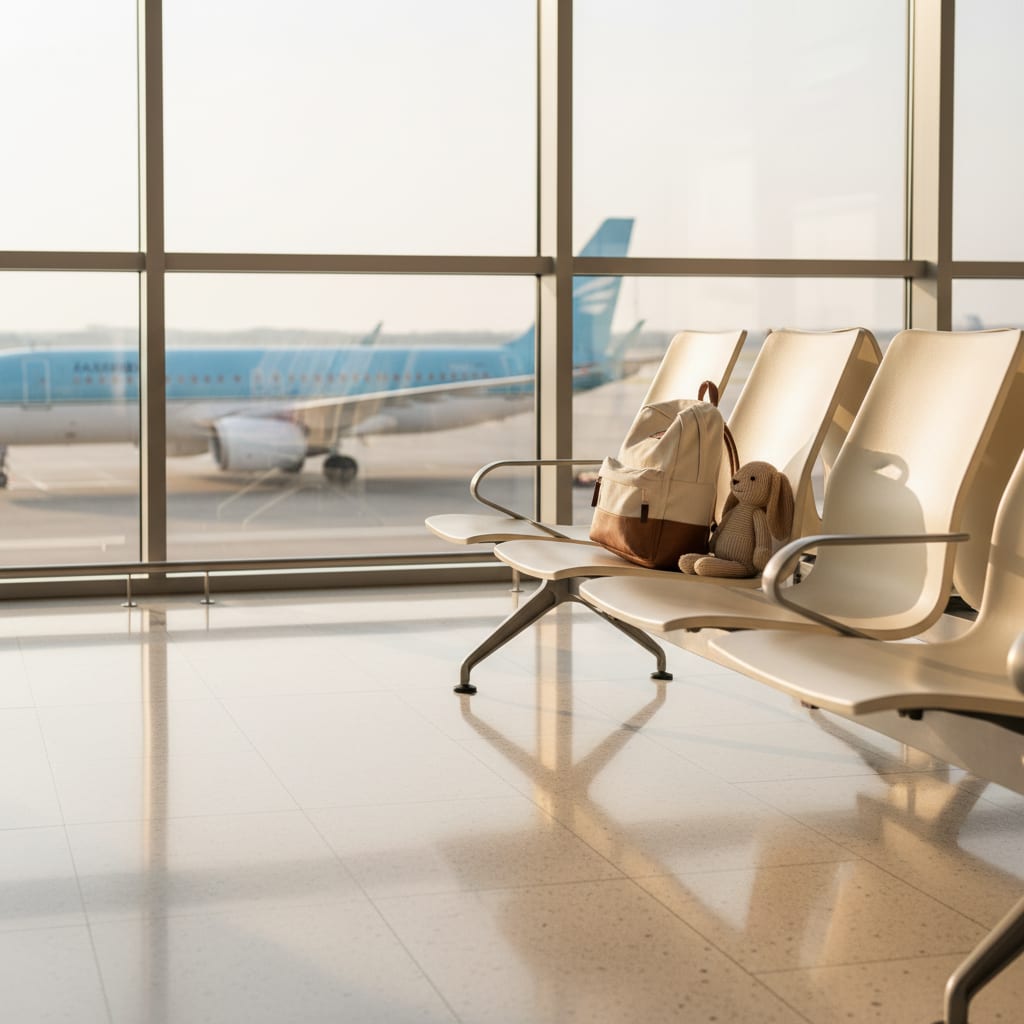
The first flight with a toddler goes wrong at the paperwork and the checkpoint far more often than it goes wrong in the air. Before you fly you need to know two things: whether your child is ticketed as a lap infant or in their own seat, because that determines what proof of age you’ll be asked for, and what happens to your stroller and car seat at security, because that’s the moment first-timers get stuck. The flight itself is usually the easy part. Here’s the whole day, in order.
The booking decision that shapes everything after it
Under two, your child can travel on your lap. From their second birthday they must have a paid seat. That single fact drives the documents, the price and the amount of gear you carry, and it’s worth deciding deliberately rather than defaulting to whichever is cheaper.
Two practical consequences most first-timers don’t see coming. A lap infant can’t be seated anywhere the aircraft doesn’t have a spare oxygen mask, which rules out exit rows and, on many aircraft, some window seats — so your seat choice narrows. And only one lap infant is allowed per adult, so two adults with two under-twos is fine; one adult with two is not.
The cost side of the lap-infant decision, including what it becomes on international routes, is its own subject — I’ve laid it out in flying with a lap infant.
The documents, and when they’re actually checked
Flying within the US. No passenger under eighteen needs photo ID for a domestic flight. But the airline is a separate matter from security: if your child is travelling as a lap infant, the airline can and sometimes does ask you to prove they’re under two. A copy or photo of the birth certificate covers it and weighs nothing. This gets asked at the check-in desk, never at the gate, and it happens more often on the return leg than the outbound.
Flying internationally. Every passenger needs their own passport, newborns included, and whatever visa or travel authorisation the destination requires applies to them too. Passports for children are valid for fewer years than adult ones, so check the expiry as well as the existence — and check the destination’s minimum validity rule, which is often six months beyond your return date.
Travelling without the other parent. Some destinations ask a parent travelling alone with a child for a consent letter from the other parent, and a few take it seriously at the border. It costs nothing to carry one, so look up your specific destination’s guidance before you go rather than after.
Check-in and gate-check
At the desk, say out loud that you’re travelling with a child and what you want to gate-check. A stroller and a car seat can normally be checked at the gate at no charge, which is different from checking them at the desk: gate-checked items come back at the aircraft door or the jet bridge, so you keep the stroller for the whole terminal.
You’ll get a tag for each item. Put it on there and then — the tag is easy to lose in a bag, and a stroller without a tag at the aircraft door is a hold-up you don’t want while a queue forms behind you.
If your toddler has their own seat and you’re bringing an FAA-approved car seat aboard, that’s a separate set of decisions about which seat it goes in and how you get it down the aisle; car seat on a plane covers the rules and the logistics.
The security checkpoint, step by step
This is the part worth rehearsing, because it’s fast and there’s a queue behind you.
- Everything comes off the stroller — bags, blankets, the snack cup. The stroller itself goes through the X-ray, folded, and so does a car seat, a booster and a carrier.
- Your child comes out. You’ll be asked to take them out of the stroller or car seat and carry them through the walk-through detector in your arms.
- Shoes stay on for children twelve and under, along with light jackets and hats.
- Milk, formula, toddler drinks and baby food come out and get declared. They’re allowed in quantities well over the normal liquid limit and don’t need to go in the quart bag, but you have to take them out and tell the officer. Ice packs are fine too. Expect them to be screened separately.
- You go through last, after your child, or with them — you’re not separated from a small child at any point.
The single thing that makes this smoother: have the declared liquids in one outside pocket, and put anything metal in the bag before you join the queue rather than at the belt.
The gate, the boarding decision and the first ten minutes
Families are usually offered early boarding. Whether to take it is a real choice: early boarding means you get the overhead space and can install a car seat without an audience, but it also means twenty extra minutes on a stationary aircraft with a toddler. If one adult can board early with the bags while the other stays in the terminal with the child until final call, take both.
Expect the first ten minutes on board to be the loudest part of your day: everyone is moving, nothing has started, and a toddler has no idea what’s happening. It settles at the moment the engines spool up. Ears bother toddlers far less than people warn — something to suck or chew on the way up and on the descent is normally enough, and the descent matters more than the take-off.
What actually goes wrong on a first flight
Not what you expect. In my experience it’s almost never a tantrum at altitude — it’s a two-hour delay after boarding has been announced, a nap that lands at the exact wrong moment, or a diaper change on an aircraft with no changing table (some don’t have one; check before you commit to a long flight with an under-three).
For the in-air tactics — the snack drip-feed, what to bring, how to recover a meltdown, and the last-hour problem — my 25 tips for flying with a toddler is the practical companion to this walkthrough. This piece is the sequence; that one is the survival kit.
FAQ: a toddler’s first flight
Does my toddler need ID to fly?
Not for a domestic US flight — under-eighteens don’t need photo ID at security. If they’re flying as a lap infant, the airline may ask you to prove they’re under two, so carry a copy of the birth certificate. International flights need their own passport regardless of age.
At what age does a toddler need their own plane seat?
From their second birthday. It’s the date of travel that counts, not the date of booking, so a child who turns two mid-trip needs a seat for the return leg.
Can I take my stroller to the gate?
Yes, on essentially every airline, and it’s normally free. Ask for a gate-check tag at the desk, keep the stroller through security and the terminal, and hand it over at the aircraft door.
What happens to my car seat at security?
It goes through the X-ray like any other item, and your child is carried through the detector. Nothing gets opened or disassembled.
Should we board early with a toddler?
Only if you need the time — for a car seat installation or overhead space. Otherwise splitting up, with one adult boarding early and one arriving at final call, gives your toddler the shortest possible time strapped into a stationary plane.