Train Travel With a Baby: Sleepers, Naps & Nights
For a long journey with a baby, a train is usually the least awful option and almost nobody considers it: you can stand up, walk, feed, change and settle a baby whenever they need it, instead of when a seatbelt sign says you may. The trade-off is that sleeping on a train is genuinely variable — a day train gives you great naps and no night, a sleeper gives you a bed you probably can’t safely share. Here’s how to pick between them, what changes at night, and the questions only the operator can answer.
Why rail suits babies better than flying does
Nothing on a plane runs on your baby’s schedule: the hours when a baby most wants to be walked are exactly the hours you’re pinned. A train inverts nearly all of it.
You can move. A corridor is a walking loop, and a vestibule is somewhere to bounce a baby at 2am without an audience. On a plane, the same baby gets a nine-inch aisle and a drinks cart.
Feeding and changing happen on your terms. No cart schedule, no “we’ll be starting service shortly”, and the changing space is usually a whole room rather than a fold-down shelf in an airplane lavatory.
No pressure changes, no gate-check ritual. The ear-pain problem simply doesn’t exist, and boarding is generally walk-on with your stroller still assembled.
The gear problem shrinks. Rail luggage limits are typically what you can carry and stow rather than a weighed allowance — check your operator, since this differs by country and service, but the shape of it is far more forgiving than an airline’s.
None of that makes a train fast. It makes it survivable, which with a baby is the metric that matters.
Sleeper or day train?
These are two different trips, and I’d choose between them on your baby’s sleep, not on the timetable.
A day train is the safer default under about six months. Two or three motion naps in a reclined stroller or a worn carrier, a lot of window-watching, and a normal night in a normal bed at the other end. The journey costs you nothing in night sleep, which is the currency that actually runs out.
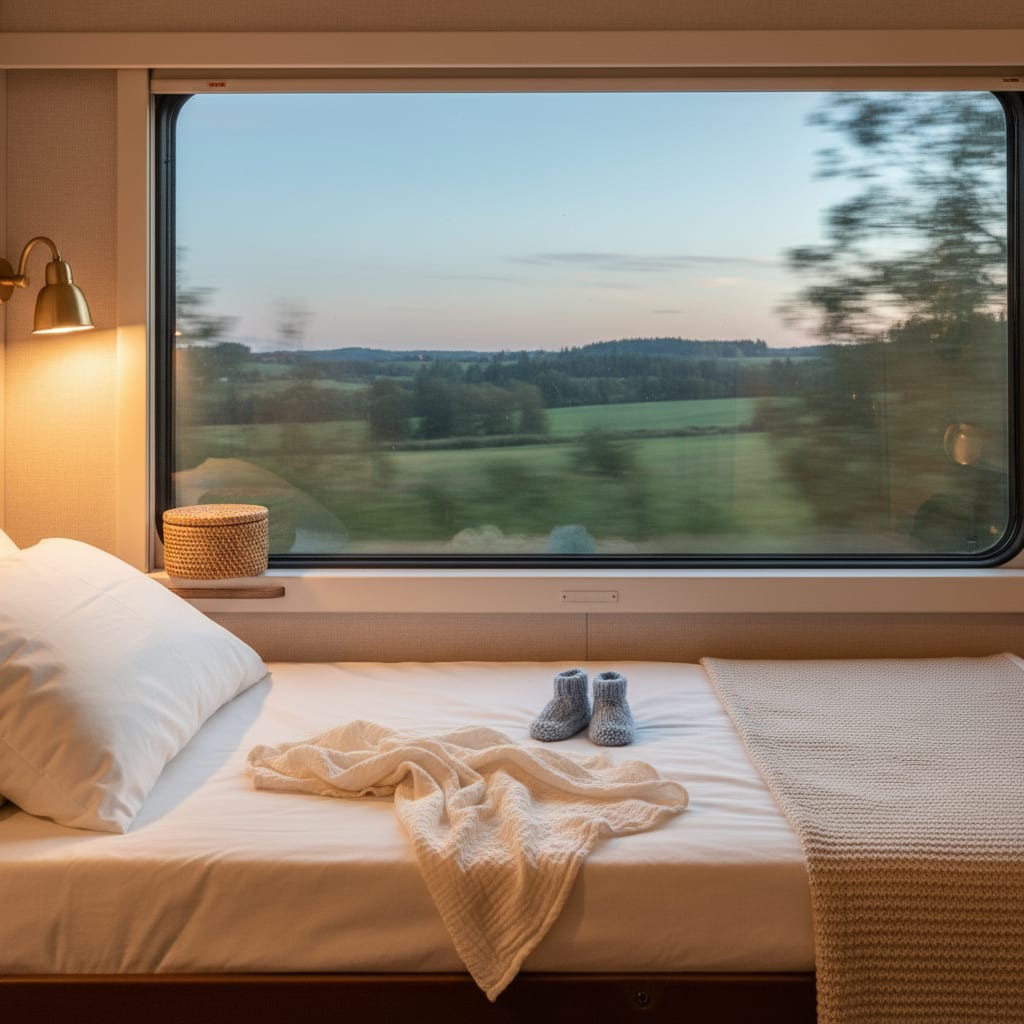
A sleeper works better once nights are settled. You get on in the evening, everyone lies down, you arrive having covered several hundred miles. The catch is the sleeping arrangement itself — the next section, and the reason many families sensibly stick with day trains.
A couchette is the awkward middle. Shared compartments with several bunks and strangers: cheap, sociable, and close to unworkable with a baby.
A private compartment beats everything else if it’s within reach. Not because the bed is better, but because you can turn a light on, talk, and settle a crying baby without an audience. That one fact changes the night more than anything else you can buy.
The safe-sleep line on a moving train
Be precise here, because a sleeper compartment quietly offers you several unsafe options dressed up as convenience.
A train berth is an adult bed: soft, often narrow, usually with a side rail on one edge only, plus bedding, and sometimes a top bunk. Sharing it with an infant is bed-sharing on a moving vehicle, with all of the usual risks and a few extra ones. The safe-sleep guidance parents are given at home does not suspend itself because you bought a rail ticket: babies sleep on their back, on a firm flat surface, in their own space, with nothing soft around them.
Two shortcuts to refuse outright. A carrier is not a sleep surface — it’s a fine way to walk a baby to sleep and a bad way to leave them sleeping while you doze. And a car seat is not a sleep surface outside a car, whatever the shape of the seat you’re on. I’ve written the full version of that argument in stroller and car seat naps, and it applies on rails exactly as it does on wheels.
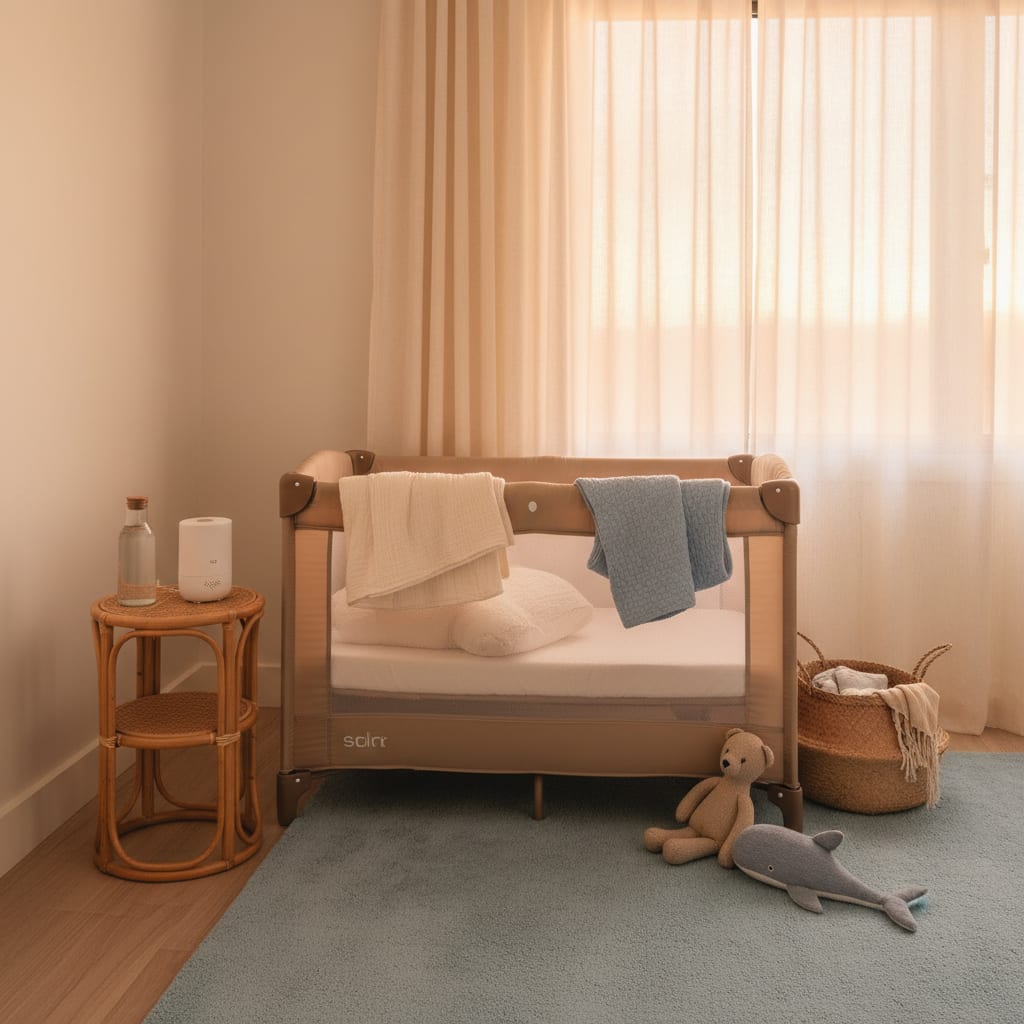
What that leaves is genuinely operator-dependent. Some services provide infant beds in certain accommodation types; some allow a travel crib if it fits the compartment; some do neither, and some set a minimum age for an upper berth. There is no universal answer, and anybody who gives you one on the internet is guessing. Email the operator, name your train and accommodation type, and ask three things: is an infant bed available, may I bring my own portable crib, and what is the minimum age for each berth. Get that before you book, not after.
If the answer is no on all counts, that’s an argument for a day train — not for improvising a bed.
What actually happens overnight
Assume the first hour is not sleep. Trains are loud in a novel way — couplings, announcements, doors opening at a stop — and a baby needs to habituate first. Blackout is easier than in a hotel, because compartment blinds are usually solid, and the motion works in your favor. Then expect the standard travel-night shape: a longer settle, more wakes than home, and a surprisingly normal morning. Bring your own white noise; the train’s rhythm covers a lot but not a platform announcement at a 4am stop.
So: run the bedtime routine at the normal time, in the compartment, in the same order you use at home — that portability is the whole point of having one, and my travel version is here. Then accept the night is a wash and protect the next day instead: late start, long morning nap, nothing booked before lunch. And if your baby simply will not go down in a strange rattling box, the troubleshooting for settling a baby quickly is more use mid-journey than re-reading the timetable.

Napping on a day train
Day trains are where rail quietly beats everything else: the carriage does half the work with constant low motion, warm light and a view that changes. Two things make it reliable. First, keep the nap where they normally nap — a stroller reclined flat, rather than on your lap where every jolt transfers. Second, cap it if it runs long into the afternoon, because a three-hour train nap borrows from bedtime at the other end. Knowing what a normal length is for your baby’s age helps you judge whether to wake them: nap length by age is a better yardstick than instinct after a 5am start.
Packing for a long rail journey
The bag differs from a flight bag in two ways: nothing has to be liquid-limited, and you’ll actually be able to reach it.
- A carrier, for the walking loop and for station changes with luggage
- A stroller that reclines flat, if your service takes them onboard — check before you commit
- Twice the food you’d bring for the same duration in the air; onboard catering is not a baby-food plan
- The portable sleep kit that makes a bunk feel like a bed — white noise, a familiar sleep sack, and the rest of the travel crib inventory
Book the accessible or family space early if your operator offers one: it’s usually the only place with room for a stroller beside the seat.
FAQ: taking a baby on a long train journey
Do babies need a ticket on a train?
It varies by operator, and often by whether the baby occupies a seat or berth. Infant fares, free travel below a certain age and sleeper berth requirements are all set individually — check the operator’s own fares page rather than assuming the airline model applies.
Can my baby sleep in the bed with me on a sleeper train?
Bed-sharing on a berth carries the same risks as bed-sharing at home, plus movement and a narrow surface. If the operator can provide a separate infant bed, use it; if not, a day train is the better trip. Your pediatrician is the authority on your particular baby.
What age is easiest to take a baby on a long train ride?
Pre-crawling babies, roughly under six months, are the easiest passengers of all. The hardest window is the newly mobile stage, around nine to eighteen months, when sitting still is the whole problem.
Is a train better than a plane for a baby?
For anything under about ten hours of ground time, often yes: no pressure changes, no seatbelt-sign timing, room to walk. For crossing an ocean, obviously not — that’s a different playbook.