Travel Day Naps: Which One to Sacrifice at the Airport
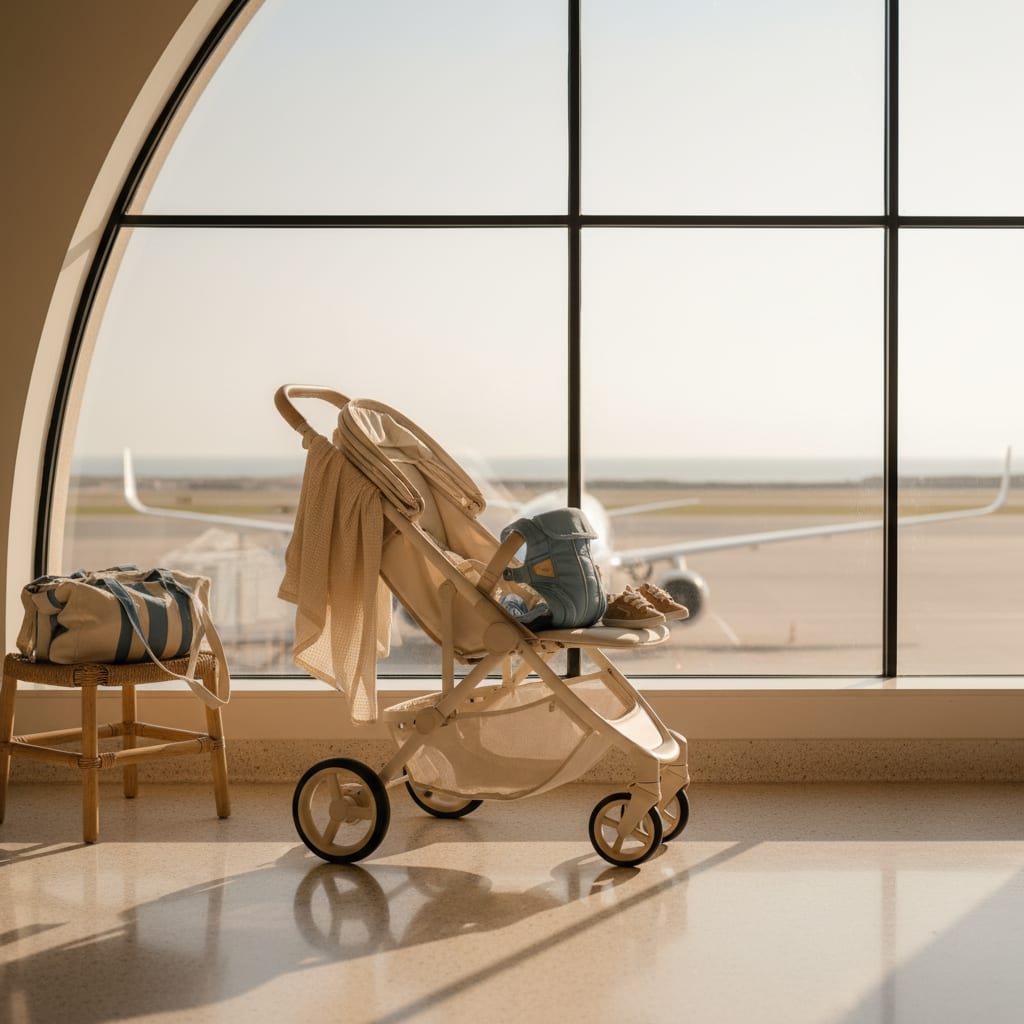
On a travel day you are almost certainly going to lose a nap — so choose which one, deliberately, before you leave the house. The rule that has never failed me: protect the first nap of the day and spend the last one. A baby who gets their morning sleep arrives at the gate regulated and can coast on a short carrier nap later. A baby whose morning nap gets eaten by a 5am alarm and an airport queue is running on empty by lunchtime, and no amount of afternoon rocking buys it back. Everything below is how to make that trade on purpose rather than by accident.
Why the first nap is the one worth protecting
The first nap of the day is the most biologically reliable one your baby has. It sits closest to the overnight sleep pressure that’s still draining out of them, it needs the shortest wind-down, and it will happen in a moving stroller, a carrier, a car seat or a dim corner of a lounge with very little help from you. It’s also the cheapest one to protect: it usually only requires leaving thirty minutes earlier than you wanted to, or picking a flight that departs after it.
The last nap of the day is the opposite. It’s the shortest, the flimsiest, the first to disappear at every nap transition, and the one your baby will fight hardest in a bright, loud terminal. It is also the one whose absence you can compensate for with an early bedtime — which, on arrival at a hotel, is something you want anyway.
So: protect the first, spend the last. If you can only defend one piece of sleep on a travel day, defend the morning.
Which nap to sacrifice, by age
Newborn to about four months. There’s no nap to sacrifice, because there’s no schedule to break. Feed on demand, keep them close in a carrier and let the day fall where it falls. The travel-day problem at this age is your arms, not their sleep.
Roughly four to eight months, three to four naps. Protect the morning nap. Sacrifice the final catnap of the day and bring bedtime forward by thirty to forty-five minutes to cover the gap.
Roughly eight to fifteen months, two naps. This is the hardest window, because both naps matter and neither is optional in normal life. Protect the morning one, treat the afternoon one as a bonus, and accept a car-seat or carrier version of it. If the afternoon nap collapses entirely, an earlier bedtime is the fix.
Roughly fifteen months to three years, one nap. You have exactly one nap and it is not really sacrificeable — a one-nap toddler with no nap at all is a genuinely difficult evening. Instead, move it: aim to have your flight, drive or transfer overlap with the usual nap window so the sleep happens in motion. This is the single biggest argument for a mid-morning departure at this age.
Past three, no nap. You’re free, but not immune. Build in one horizontal hour somewhere — a hotel bed, a picnic blanket, a long stroller push — before the evening.
Where the surviving nap should happen
The nap you keep needs a venue, and on a travel day the venue is always motion.
The carrier is the most reliable sleep surface in an airport. It works in a security queue, on a moving walkway and standing at a gate. If your baby only naps in a cot at home, do two or three carrier naps in the fortnight before you fly so it isn’t a novelty on the day.
The car seat covers the transfer nap. Long taxi or rental-car runs from the airport are a gift; plan for the drive to land inside a nap window rather than fighting to keep a child awake through it.
The plane itself is a coin toss. Take-off and landing are stimulating, cabin lighting is unhelpful, and the seatbelt sign has no interest in your schedule. Assume the plane will produce a short, poor nap and treat anything better as a bonus. My flying with a baby guide covers the cabin logistics that make it more likely.
Airport quiet corners genuinely help. Find the emptiest gate on your concourse rather than the one you’re departing from, face the stroller away from the light, and use white noise from your phone.
Building the travel day backwards
Start from the departure time and work back rather than forwards, because the only fixed points on a travel day are the ones the airline gave you.
If your flight departs mid-morning, the morning nap has to happen before you leave home or in the car on the way. Wake at the normal time, take the nap at the normal time, and leave straight afterwards. If your flight departs at dawn, you have already sacrificed the morning nap by getting up at 4am — so re-plan the whole day around a long carrier nap once you’re airside, and protect the afternoon instead. If your flight departs mid-afternoon, put the toddler’s single nap in the car or at home first, and don’t try to also get one on board.
The failure mode to avoid is having no plan and hoping. That’s how you end up with a baby who’s been awake for six hours in a terminal, at which point you’re not managing naps — you’re managing an overtired baby, which is a much harder job and one that follows you into the night.
When the sacrificed nap doesn’t happen at all
Sometimes you lose both. When that happens, three things salvage the evening.
Bring bedtime forward, hard. An hour earlier than normal is not too much after a lost day of sleep. Overtiredness does not respond to a later bedtime; it responds to an earlier one.
Do the full bedtime routine anyway. Same order, same songs, same sleep sack, in a hotel bathroom if that’s what’s available. The sequence is the cue, not the room. My baby sleep while traveling guide has the portable version.
Write off the first night and plan the next day gently. Expect fragmented sleep, plan nothing before ten the next morning, and let the schedule rebuild itself over two or three days. If you’ve crossed time zones as well, baby jet lag is a separate and slower problem.
If travel-day sleep is exposing a schedule that was already shaky before you left — naps that were too short, wake windows that never quite fit — it’s worth mapping out an age-appropriate schedule before the next trip rather than during it.
FAQ: naps on a travel day
Should I keep my baby awake so they sleep on the plane?
No. Deliberately skipping a nap to bank sleep for the flight almost always backfires — an overtired baby is harder to settle, not easier, and the crash usually arrives at the least convenient point. Take the nap when it’s offered.
Is it better to fly at nap time or at bedtime?
At nap time, for most families with children under three. Overnight flights sound efficient but produce broken sleep for everyone and a wrecked arrival day. A mid-morning departure that overlaps a nap window is the friendliest slot there is.
What if my toddler naps only in their cot?
Practise before you travel. Two or three deliberate stroller or carrier naps in the weeks before the trip turn an impossible ask into a merely difficult one, and they’re worth more than any gadget you can pack.
How long should a travel-day nap be?
Whatever you can get. Twenty minutes in a carrier meaningfully takes the edge off, even though it isn’t a real nap. Don’t wake a baby who’s finally sleeping in a terminal to make a boarding queue you can join five minutes later.
Will one bad travel day ruin the whole trip’s sleep?
Usually not. Most babies re-regulate within two or three days if you protect bedtimes, keep the routine consistent and don’t overcorrect with late nights. A nap strike on vacation is the more common culprit for a genuinely rough week, and that has its own fix.