Hotel Room Naps: When There's Nowhere Dark for a Crib
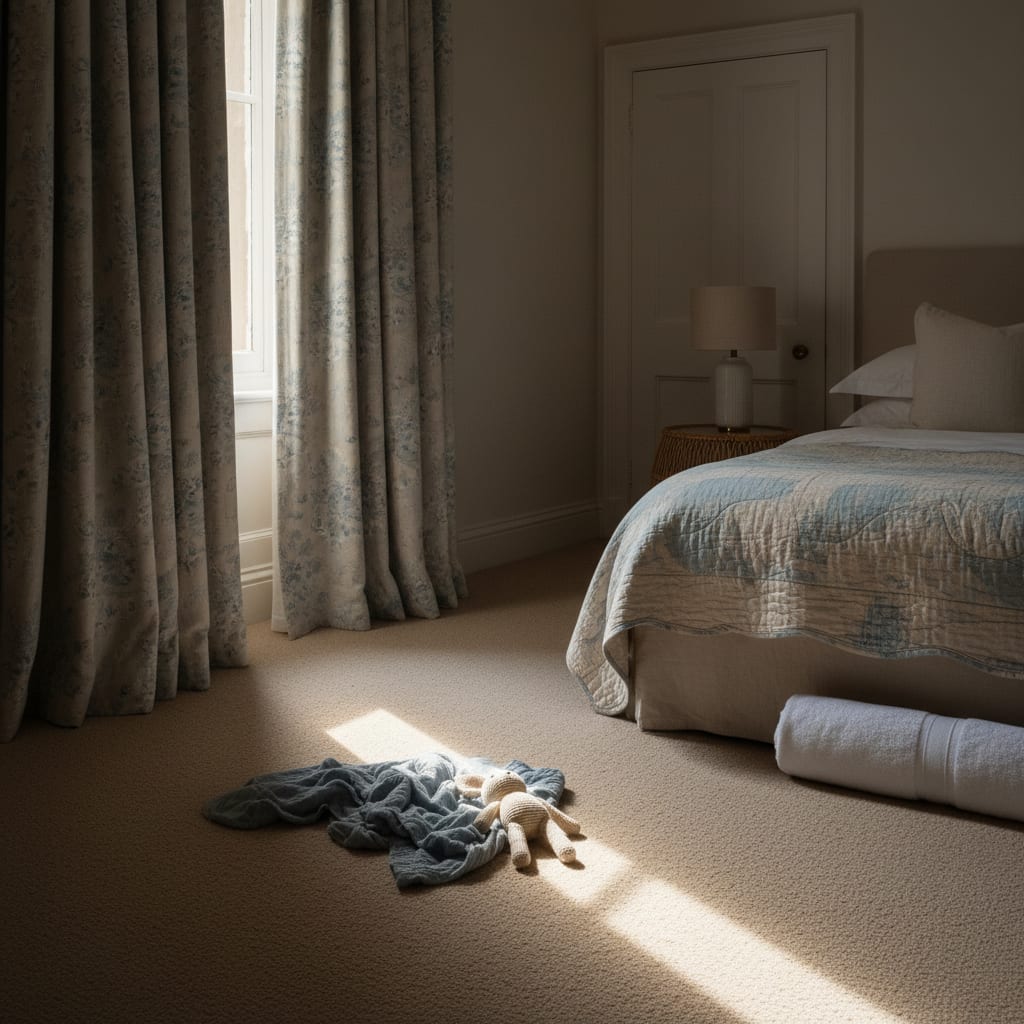
If there is nowhere dark to put the crib, make the darkness rather than hunt for it: close the drapes and clip the centre gap shut, kill the two or three small lights that stay on in every hotel room, and put the crib on the floor on the far side of the bed, out of the window’s sightline. That gets most rooms to nap-dark in about five minutes. If it doesn’t — bathroom, closet alcove, or stroller. A daytime nap does not have to happen in the crib. It has to happen.
Why the daytime nap is a harder problem than the night
At eight in the evening the sun has done most of the work for you. At one in the afternoon it has not: sheer inner curtains glow, the blackout drapes leave a two-inch gap where they overlap, and the balcony door lays a bright strip along the floor.
The bigger difference is that the room is also the only place the rest of you can be. Night sleep in a shared room is a problem you solve once and then lie still in the dark. A nap is one you solve while somebody stays awake in the same twelve square metres, with a suitcase to get into. My hotel room sleep setup covers the night version; this is the two o’clock version.
The five-minute light audit
Do this the moment you walk into the room, before anyone is tired, because doing it with a screaming baby on your hip is a completely different experience.
Pull the drapes and look at what’s left. Almost every hotel has good blackout fabric and a bad seam. The centre gap is the single biggest light leak in the room and it takes one clip to fix — a clothes peg, a chip clip, or the trouser clamps on the hangers in the closet, which are in the room already and cost nothing. Clip the two panels together at eye height and again lower down.
Look at the edges. Light comes around the sides and over the top of most hotel drapes. Tuck the outer edge behind the sofa or the desk to hold it flat.
Find the small lights. There are always more than you think: the bathroom night light, the LEDs on the smoke detector and thermostat, the standby dot on the TV, the strip under the door. A rolled bath towel along the door handles the corridor; a folded washcloth covers most of the rest.
Then get down at crib height and look up. That’s the view your baby actually has, and it is usually brighter than the view from standing.
What actually travels
Two things are worth their suitcase space, and only two.
A suction-cup blackout panel is the highest-value item in the bag. The Gro Anywhere Blind sticks straight onto the glass with suction cups, packs down to about the size of a rolled sweater, and turns a bright window into a dark one in roughly a minute. It fits down to about a third of its full size. It won’t beat an entire wall of glass — nothing does — but it will cover the pane the crib sits under.
A blackout canopy solves a different problem: privacy, not just light. The SlumberPod goes over a travel crib or playard and darkens the sleeping space rather than the room, which means you can keep a lamp on and be a functioning adult while your baby naps two metres away. It’s rated from around four months, and the maker’s guidance on ventilation and heat is the part to actually read. My travel crib roundup has more on how the two pair up.
Things that sound clever and are not: bin liners and tape, which fall off, mark paint and get noticed; and the towel-over-the-rail trick, which works until it slides.
If you’d rather understand the underlying question — how dark is dark enough, and whether it matters at nap time as much as at night — Betteroo’s rundown of blackout blinds and what actually works is the clearest thing I’ve read on it.
When the room has no dark corner
Some rooms defeat you. Floor-to-ceiling glass, a bright white balcony, drapes that stop six inches short. Here is the order I work through.
The far side of the bed. The floor between the bed and the wall is usually the darkest square metre in the room, and the bed blocks the sightline to the window. Crib goes there.
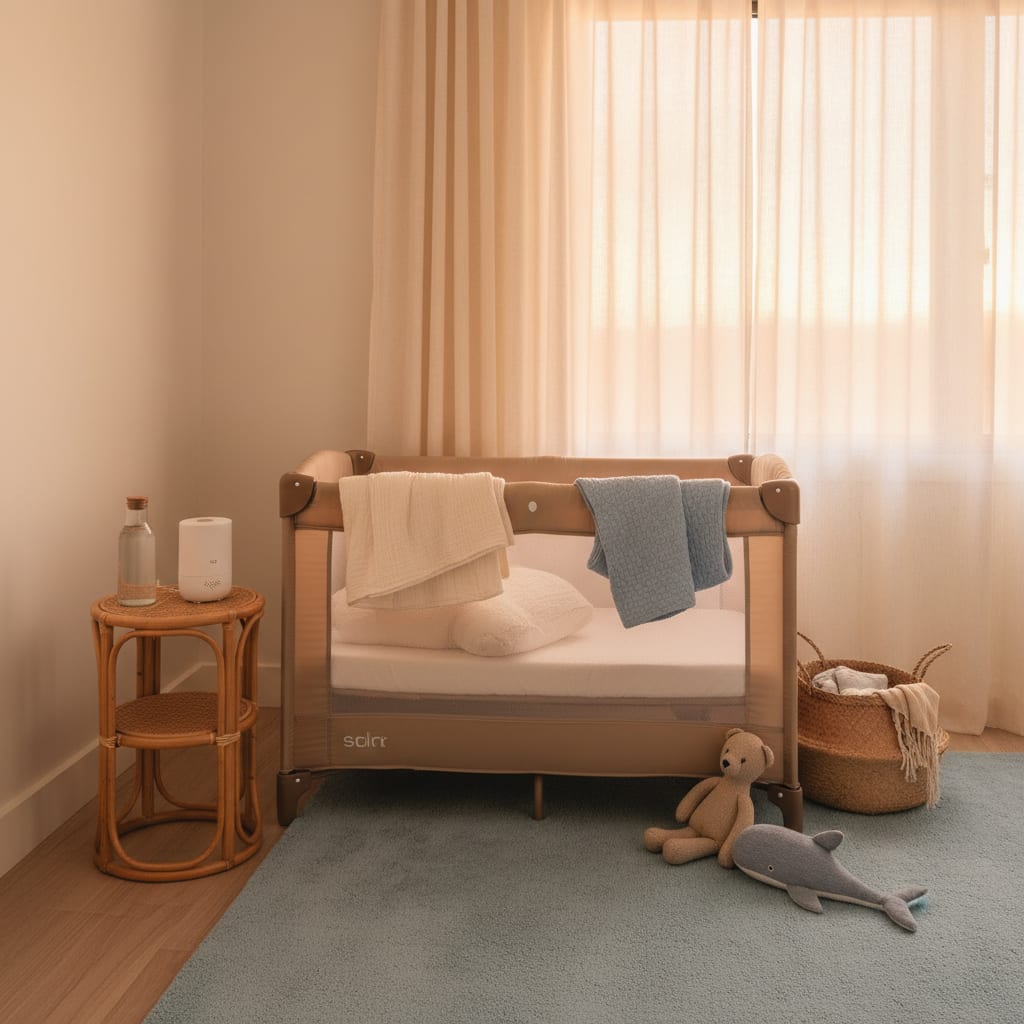
The bathroom. It has no window, a door you can close to a crack, and an extractor fan that doubles as white noise. The rules I hold to: the travel crib or playard goes in there with its own flat firm mattress and nothing else in it, the door stays open a few inches for air and so you can hear, nothing is running, and the floor is dry. Not the bath, not a nest of towels, not a folded duvet. If the crib physically won’t fit through the door, this option is out — don’t improvise a substitute.
The closet alcove. In bigger rooms the dressing area is a real option and often has a door. Same rules: the crib, ventilated, door ajar.

When to stop fighting and nap on the move
There is a point where the room has cost you forty minutes and produced nothing, and the honest answer is to leave. A stroller nap in deep shade, a carrier nap while somebody walks, or a drive — all real naps, and often the better ones on a trip.
Two caveats. First, a nap on the move tends to be shorter and lighter, so treat it as a bridge to an earlier bedtime rather than a full replacement; I go through which nap is worth defending in travel day naps. Second, a week of motion naps builds a habit faster than you’d expect — if the stroller becomes the only place sleep happens, unwinding the motion loop takes about a week once you’re home.
Let the length of the trip decide how hard you try
On a two- or three-night trip, don’t run a darkness project. Take the easy naps wherever they land, protect bedtime, and go home. On a stay of a week or more, spend the first afternoon getting the room genuinely dark — you’ll bank that investment ten or twelve times.
And if the room is hopeless, ask at the desk. A lower floor, the courtyard side, or a balcony overhang is usually free to move to on day one and impossible on day three.
FAQ: naps in a hotel room
How dark does a hotel room need to be for a nap?
Dark enough that you can’t comfortably read in it. You’re not chasing pitch black — you’re chasing the absence of a bright spot in your baby’s sightline. Closing the centre gap and moving the crib out of the window’s line does most of that.
Is it safe to let a baby nap in a hotel bathroom?
It can be, with conditions: the baby sleeps in a proper crib or playard on a flat firm mattress with nothing else in it, the door stays ajar for ventilation, the floor is dry, and nothing is running. The bathroom is a dark room, not a bed. If those conditions can’t be met, use the far side of the bed instead.
What if my baby will only nap in the crib at home?
Bring as much of the crib environment as you can — same sleep sack, same white noise, same wind-down order — and accept that the first nap in a new room is the worst one of the trip. Most babies settle by day two or three.
Should I skip naps altogether on holiday?
No. Skipped naps buy you an afternoon and cost you the evening and often the night. If the nap can’t happen in the room, move it to the stroller or the car rather than dropping it, and bring bedtime forward by twenty to thirty minutes to cover the shortfall.
Does housekeeping ruin all of this?
Frequently. Hang the do-not-disturb tag the moment you check in and leave it there all stay; request towels at the desk instead. A knock at ten past one has ended more naps in my life than jet lag has.